

Dearest Reader,
What a lively discussion! And so many poll participants! My last column really hit a chord and I was overjoyed. Thank all of you who participated.
For example, responding to my statement that “Gardening exotic plants in North America requires much more labor, knowledge, and inputs for less satisfying results [than in the U.K.],” Alexandra from the Misplanted Substack responded, “YES! … Because it’s a design mismatch!” I so agree. I delve deeper into the burden of our horticultural legacy in “Why?” below.
And almost 500 of you answered the poll, confirming a slight bias for strolling counterclockwise (59%) vs. clockwise (41%) around our yards. According to researchers, it’s a uniquely human biomechanical asymmetry, which is stronger in young people. Like the majority of you, Pete and I stroll our yard counterclockwise—and I’m sharing a video of our circuit in “Wow!” But, like many of you, we also like to shake it up, walking the opposite direction to experience our garden from a completely different perspective.
But the comments I’ve been ruminating about are the responses to my request for turf removal recommendations, because the fan favorite method is my least favorite. Readers like covering an area of lawn with wood chips and planting into them, called “sheet mulching” or “the lasagna method.” I dislike this method partly because, as reader Kai said, “I have a huge fear of jumping worms.” I also want my herbaceous plants to spread as quickly as possible and wood chips inhibit this spread.
When challenged, wood chip fan Amanda—who keeps excellent records—says aggressive forbs (Monarda fistulosa, Zizia aurea, Solidago rigida, Rudbeckias, and Violas) have spread, but others not so much. She expects less aggressive forbs will spread when the chips break down, but that can take many years.
Which brings me to the main reason I dislike the wood chip method: I DETEST THE LOOK OF MULCH. And thick layers of wood chips look and act like other mulches. This is an aesthetic preference, not an ecological imperative; wood chips are ecologically superior to bark mulch, though the addition so much organic material is unnecessary. I would much rather see turfgrass than mulch in my establishing perennial beds and rely on the same species thriving in Amanda’s wood chips to eventually outcompete the turfgrasses.
You could say mine is a more relaxed approach. I allow many volunteers to persist in my beds, while removing others, depending on my aesthetic goals, as well as their invasiveness. I encourage violets everywhere, which another wood chip fan works hard to eliminate. But, frankly, my antipathy to mulch makes me anxious, requiring all my mindfulness skills and emotional self-restraint to keep my blood from boiling during Pete and my constitutionals around our Rhode Island neighborhood.
Having tried them all, my favorite method of turf removal is not to remove the turf, but to plant into it instead. However, as my late father often said, “De gustibus non disputandum est.” (In matters of taste, there is no dispute.)
—Heather
Why, How, Wow!
Why? The burden of our horticultural legacy
When evaluating gardening practices—like the turf removal methods—I try to think like an ecosystem, not like a farmer. And consult original research. Because, unfortunately, most of what we learned about gardening growing up—even organic gardening and even today from AI and the internet—is toxic, wasteful, or counterproductive. If we want joyful, easy-care yards that are healthy for ourselves and other living things, we have to forget a lot of what we think we know about gardening. So here are my takes on various old precepts, based on research. I look forward to hearing your thoughts in the comments.
Let’s start with, “Till the soil so roots can penetrate easily.” Forget it. In fact, half of U.S. farmers don’t even till these days. Tilling destroys soil structure and encourages erosion. Plant roots—especially native plant roots—don’t need our help; they evolved to work their way through the soil.
Ever hear this one? “Your USDA hardiness zone indicates what will thrive in your yard.” Forget it. Hardiness zones merely indicate the extreme minimum winter temperature. They don’t reflect rainfall, length of dry periods, high temperatures, or numerous other environmental conditions that affect plant survival. For example, Zone 10 includes both Los Angeles and coastal Sarasota, Florida. The plants that thrive without intervention L.A.’s 14 inches of annual rainfall are completely different from those that thrive in Sarasota’s 52 inches of rain. On the other hand, if something’s native to your area, you know it evolved to deal with the general weather conditions there.
How about this? “Plants need plenty of space and sunlight.” Forget it. Plants evolved and thrive in cooperative communities, packed closely together—as in a prairie—or filling mostly shady vertical layers from the ground to the canopy—as in a forest. While you’re at it, forget the fundamental idea of nature as unfettered competition. Plants actually share food among each other via vast mycorrhizal fungi networks. And after a fire or other disturbance, early succession plants shade more tender, slower-growing species, protecting them from harsh sunlight.
And this? “Plants need fertilizer.” Forget it. They don’t even need compost. At least, not if you don’t remove their sources of nutrients by harvesting them to eat or removing dead stalks and leaves. Myriad organisms in natural ecosystems decompose dead plant material and return nutrients to the soil to nourish new plants. Amending soil with organic matter, topsoil, and fertilizers is a traditional horticultural practice that’s counterproductive in a native garden. Amendments encourage weeds and can super-size native plants, causing them to flop over.
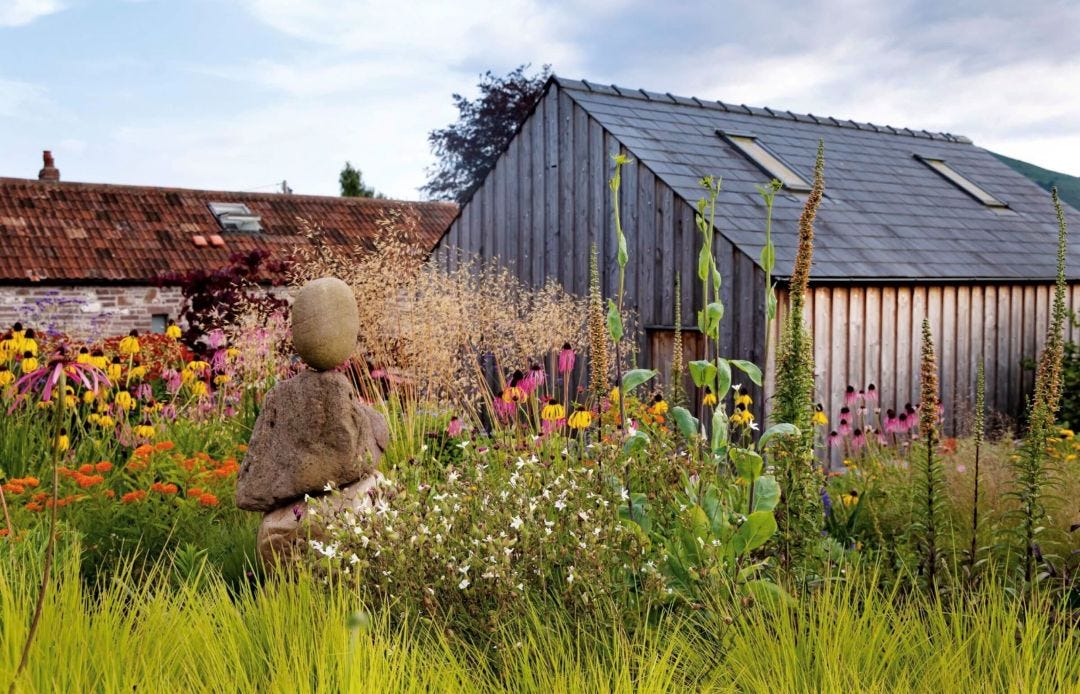
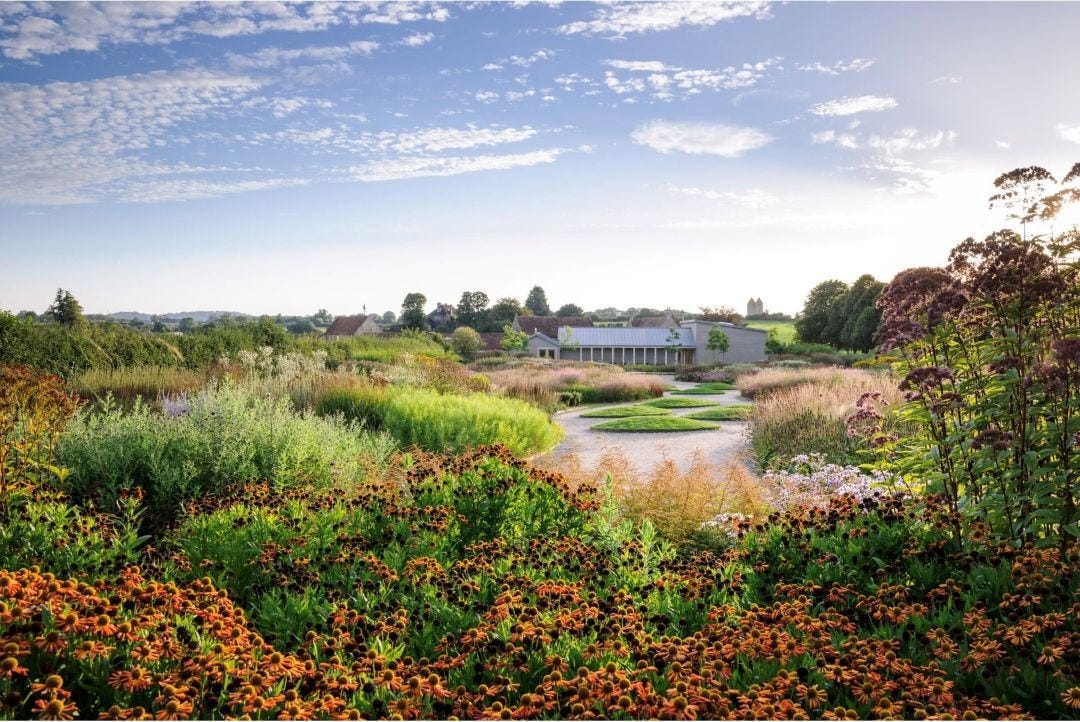
As an aside, the Brits still have a mania for amending or replacing soil in order to grow exotic plants—including American plants, including in “naturalistic” styles. For example, five inches of sand was spread over a former building site to create the prairie above. And to create the the Oudolf garden pictured below, “The highly fertile soil was changed out at the start for poorer soil, an expensive option not open to many people.” (The English Garden)
You’ve heard, “Organic pesticides are safe?” Forget it. Naturally derived pesticides may be safer for human consumption, but most kill insects indiscriminately. And insects, especially caterpillars, are the base of our terrestrial ecosystem. No caterpillars, no terrestrial birds, for starters. Plus, insects are beautiful in their own right (happy National Moth Week, everyone!).
These and more traditional horticultural precepts reflect an agricultural model. Forget all that! Sustainable landscaping is different. Even if you have a vegetable garden, most of the other plants in your yard are not crops. So there’s no reason to put in the work, resources, or harmful chemicals to make each plant a perfect specimen.
And that brings me to slut-shaming plants that “seed around” or are “aggressive.” These are the plants I love most! We need these plants to outcompete invasives and replace sections of turf. Replacing half the lawn in the average American residential lot (14,000 square feet) requires about 5,000 plants. Bring on the yarrow, bee balms, mountain mints, black-eyed Susans!
When you think like an ecosystem, you think in terms of nurturing a community. It’s a much less stressful way to manage your piece of land: You’ll celebrate, rather than stress, when you see holes in leaves; you’re feeding caterpillars. You’ll welcome the autumn leaves that fall on your garden; they’ll enrich your soil. You’ll chill when you see aphids; ladybird beetles and parasitic wasps will take care of them. You’ll even embrace a dead tree, knowing that its contribution to the community will be as great when it’s dead as when it lived.
How: Turf removal methods continued
Like many readers, I’ve used all the turf removal methods and, as Kristine commented, none is perfect. She recommends Xerces’s 48-page Organic Site Preparation Guide, with pros and cons of each method summarized in this Comparative Overview.
My own favorite, especially for shade, is not included in the Xerces guide. Here’s how solsticecrown timidly described this approach:
I’m a novice with no idea if it going to work, but I had a bare area under my oak with grass majorly struggling to grow and few invasive (yet). I couldn’t afford … plugs throughout and didn’t want to leave it vulnerable to the invasives (creeping bellflower, gout weed, creeping Charlie) that eye any bare spot they can find, so I decided to just put the plugs (carexes, wild geranium, wild strawberries, black cohosh, wild ginger, a few nannyberry bushes…) that I got into the bare spots, stop mowing, let the oak leaves fall and see what happens!
Kristine, a chip method fan, had some success with another variation of the plant-into-turf method:
Scalp the grass and plant shrubs… I discovered this advice from CSU Extension in one of the more southern (drier, hotter) counties in Colorado. Basically, mow your grass super low then plant (native) shrubs and water them only at the base. It was okay-ish. I added mulch after a while.
Finally, giving the wood chip method fans equal time, here is Amanda’s version, which in three years resulted in a front yard “lush with native plants and has practically no grass or weeds.”
1) Mow your lawn down to the lowest possible setting.
2) Sign up for ChipDrop at https://getchipdrop.com/. This free service connects landscapers who have tons (literally) of wood chips to get rid of with gardeners who want them. It works best if you have a driveway where they can dump a massive quantity of chips. The chips may arrive unexpectedly, so be on the alert!
3) Spread the chips in a layer about 4-6 inches thick all over your mowed lawn. My understanding is that it is NOT necessary to spread cardboard or plastic or newspaper over the lawn before laying down the chips, and that in fact, it is better to just put the chips directly over the grass, because that allows air and water to percolate down into the soil.
4) Do nothing for a few months, while the grass decomposes and the chips slowly begin to decompose too.
5) Plant your native plugs directly into the chips, ideally in the fall -- as long as the bottoms of their roots are in the soil, they should be fine.
Wow! Walk with me?
Yesterday, Pete and I hosted forty or so neighbors in our purple parterre as one leg of a four-stop “porch crawl.” I was hoping some of them would love the look of our yard and want to plant more natives in their yards. And it worked! We received lots of compliments and questions, so I’m hoping we’ve sparked interest in ecological landscaping.
I wanted to share the garden with you, too, so I made this video of my daily stroll—which I do multiple times a day, especially after meals and during writing breaks. A UK meta-analysis found that just five minutes in nature boosts self esteem, and five minutes strolling the circuit of our yard certainly boosts mine:)
We started transforming it four years ago and have gradually replaced turf with native plants a section at a time. In case you’re wondering, our turf removal methods included a sod cutter, solarization, and planting directly into the turf.
Wildr Places News

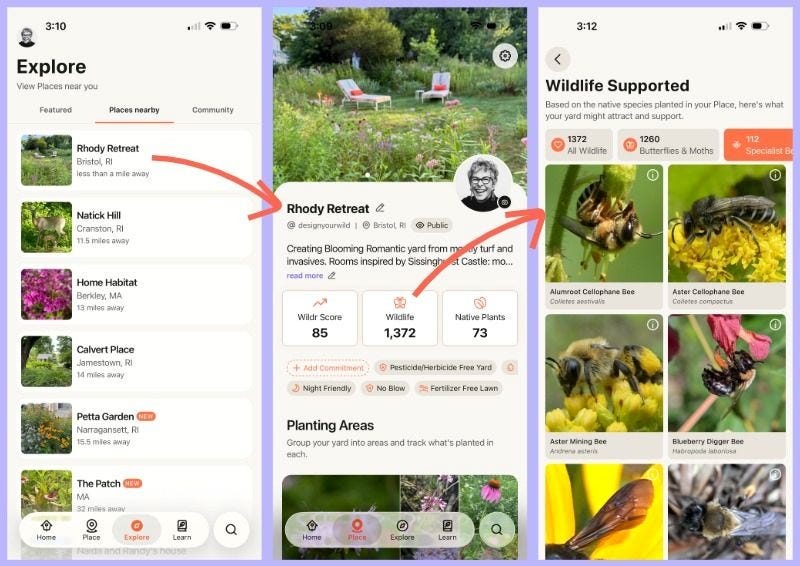
Last week, both Joe Gardener and Gardenista’s Laura Fenton featured interviews with my daughter Zoe about the Wildr Places app. They both love the app, especially the “Places nearby” feature. As Joe said,
I found out when I was on the app... there’s quite a few people around me that are already on the app and submitting their photos. So I have a few neighbors I need to meet based on that.—Joe Gardener Podcast, Wildr Places App Offers Ecological Gardeners Guidance and Motivation
And Laura took action:
When I saw that no one in my area had posted yet, I decided to flip my profile to public in the hopes of encouraging other gardeners to do the same.—Laura Fenton, How Ecologically Healthy Is Your Garden? There’s an Easy Way to Find Out
This is exciting because research shows seeing someone nearby already doing it is one of the strongest motivators of environmental behaviors. It’s also just fun to look at what others are doing (especially when it seems as if all your neighbors are using mow and blow crews that isolate plants in piles of mulch, ahem).
If you haven’t yet set up your “Place” in the Wildr App and made it public, consider taking time to do it now. And maybe you’ll encourage others nearby who are dipping their toes in ecological landscaping. (You can download the app at joinwildr.com.)
Digging Deeper
Still amending your soil? No scientific studies to date show any measurable benefit of soil amendment except in containerized plant production. Learn more at The Myth of Soil Amendments, Washington State University.
ICYMI, you can watch recordings of the latest Less Lawn More Life webinars: building a natural pond with Robert Pavlis and making art and habitat from yard debris with Edwina von Gal.
A newly study conducted in Uganda found catnip lotion as effective as DEET in repelling mosquitoes.
I still find it difficult to capture the immersive experience of gardens in still photographs, but Jason Ingram’s advice helped.
You can read more about my mulch obsession in Mulch Ado About Mulch.

I'm finding mulch to be fantastic as a temporary measure rather than a permanent one. If you have the materials, smothering edge areas with something that will break down relatively quickly is a great way to prevent soil errosion in barer spots while you establish new plants until they can seed and spread on their own. You don't need to mulch so heavily that you smother out the "seed bank" and completely prevent things from popping through. Planting into thick turf and/or turf mixed with very aggressive invasives has not worked nearly as well for me. Especially when you're trying to establish native graminoids (which everyone should).
Kelly Norris says: "Just keep planting". Also, 4 years ago, I shook herb seeds in my "lawn" and now I have thyme, violets, mints, self-heal and more growing in the "grass" which is cut at the highest level of my mower a couple times a month.
I started with your standard square suburban lawn years ago. I edged the grass creatively years ago to give a defined edge between "lawn" and wildness. Every couple years I move the rocks further into the the "lawn". When I do this, I put newspaper under rocks. After 20 years I a very small patch to mow which is grand for an elder.