

Dear Yardener,
I am THRILLED by the many great questions from readers after our last newsletter! I will answer four today and more in two weeks. As always, I try to illustrate ecological landscaping approaches we can all use when replying to specific questions.
I also want to encourage you to join my daughter Zoe and me live TODAY, August 18, at 6 p.m. Eastern time for Design a Yard You Love: Quick & Easy Layouts if you have not already participated in one of our design workshops. It’s free, it’s fast, it’s fun, and it’s interactive. By the end, you’ll have two sketches to transform your yard with paths, destinations, and green enclosure. These—not plants—are the most important elements of a restorative landscape, according to research.
Dear Design Your Wild, I want to add a patio in my backyard. I believe you’ve mentioned areas in the shapes of circles and rectangles help signal “I have arrived” to a “destination” within the yard/garden. What are your thoughts about squares or half circles? Besides the golden ratio, is there anything else to consider regarding the lay out? I have already dragged the table and chairs to the area to get a sense of it and mowed the grass around it to get a feel for what it might be, but it’s an expensive thing to get wrong.—Bridget
Wow, sounds like you paid attention during Zoe and my workshop! Yes, regular shapes signal to our brains “you have arrived”—and those shapes can absolutely include squares, half circles, ovals, even kidneys and other intentional-looking biomorphic shapes. Besides the golden ratio and testing views and comfort with furniture (go, you!), I suggest considering:
Size: If you have room, err on the larger side—without sacrificing space for additional seating destinations around your yard. Ideally, dining areas should be at least three feet larger than the table in each direction in order for people to pull out their chairs—and at least four feet for someone to walk behind a diner. If you plan to include both dining and lounge areas on your patio, make sure to leave plenty of space to walk between them and, potentially, for party guests to mill around.
Material: Keep an open mind about material. If the optimal size is too costly, you’ll get more enjoyment from a larger patio in a cheaper material than you will if you skimp on size. And make it permeable, if possible. Zoe and my entertaining areas are both twenty by thirty; mine is a turf oval, hers is gravel in a kidney shape. Home Depot’s 24-by-24-inch concrete pavers, at only $2.49 per square foot, look super chic set in warm-colored gravel at architect Jim Estes’s home in San Antonio, featured in The New York Times [gift link].
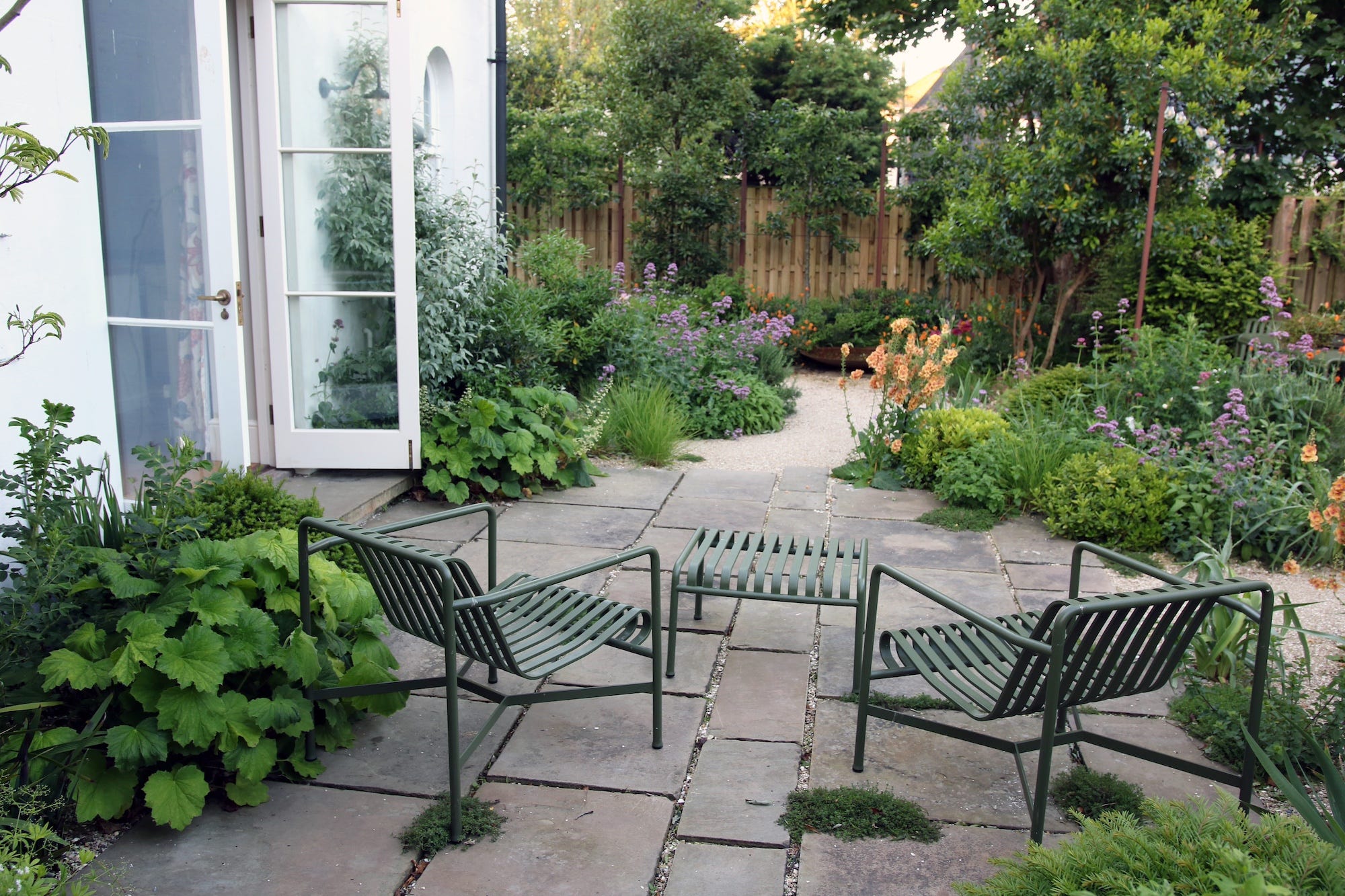
Room for plants: Float your patio amid plants by leaving three to ten feet (or more) for planting between it and the house to create a comfortable sense of green enclosure. Make a path to connect it to the door. Surrounding your patio with greenery is possible even in small, urban garden like the one pictured above. (Deep-rooted plants also mitigate basement water intrusion.)
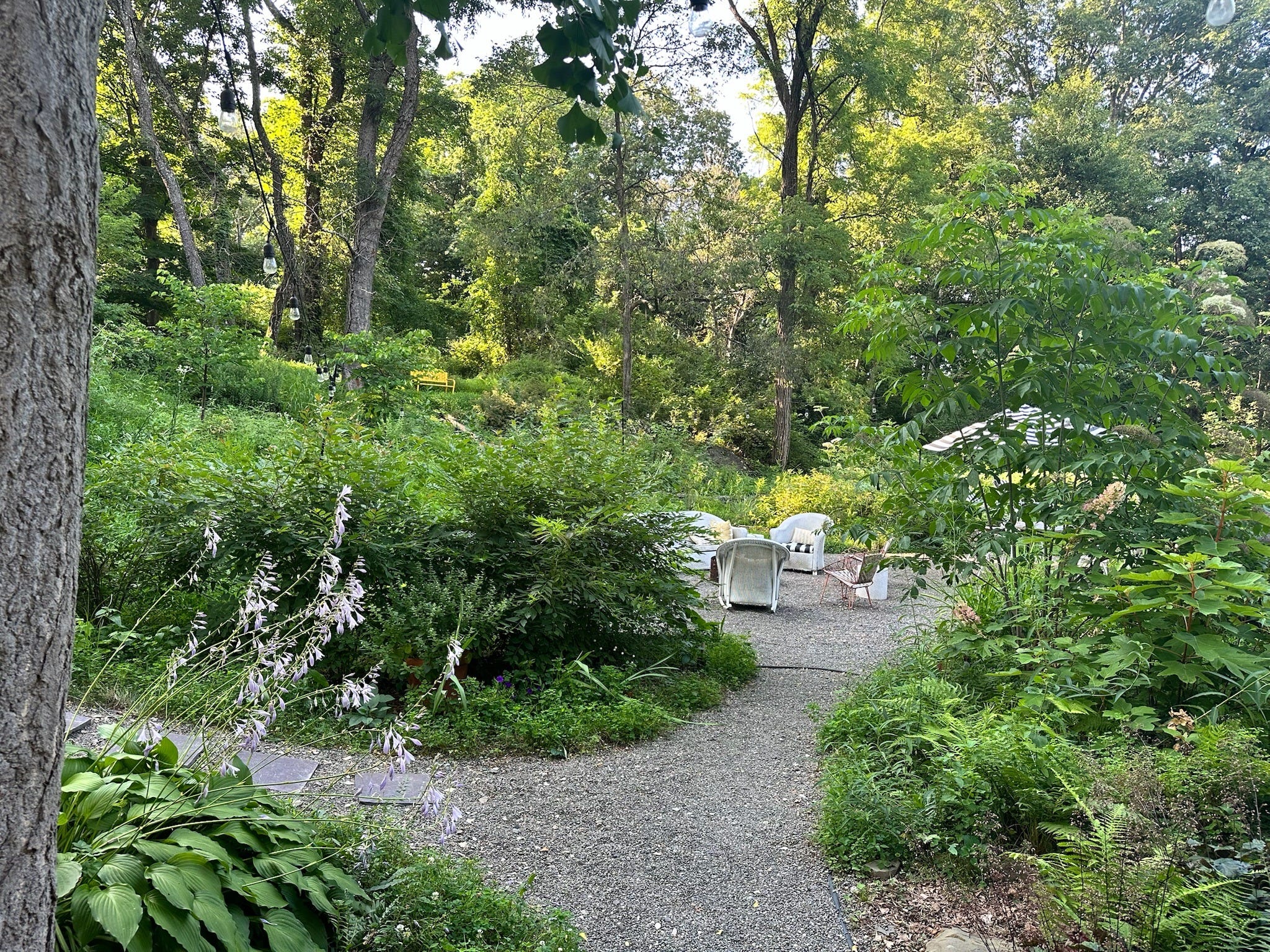
Thermal conditions: Hardscape retains and radiates heat, which can be good and bad. Think about the position of the sun at the time of day (and time of year) when you’ll most often use the patio. Where can you plant a tree or trees to make the patio more comfortable? Deciduous trees, which lose their leaves in winter, allow sunlight in cold weather, as do vine-covered arbors. If you’re tempted to use an umbrella, think about whether a second destination—one in sun, one in shade—would get you to use more of your yard more often. (I’m assuming you’ve already consider all-important privacy…)
ROI: Plants more than pay for themselves in terms of what they add to the value of your house. Hardscape often does not. Concrete patios have an ROI of 50 to 90 percent, “depending on design quality, finish complexity, and your local climate,” according to Angi (formerly Angi’s List), with patios in warm climates returning more because they can be used for more of the year. I recommend reading Angi’s analysis (and taking it with a grain of salt). And keep in mind that, as with softscape, the ROI will be higher if the project fits neighborhood norms for quality and style.
All that said, I’m confident you’ll reap tons of joy from adding a seating destination to your yard. The more I study the health benefits of spending time in nature, the more important I believe paths and destinations are to getting us to use our yards and reap the physical and mental health rewards.
P.S. Again, if you haven’t participated in our fundamental yard design workshop, please join us later TODAY. (I’ll circulate the recording in the next newsletter, but it’s more fun live.)
Dear Design Your Wild, I am trying to establish clover in my yard. I seeded in the spring but it got really hot early and the clover turned yellow and died. I’m new at this but working on having natives in my yard. Any advice?—Colleen, Hephzibah, Georgia
Hmmm, was the clover seed grown and collected nearby? Plants that thrive in your area have slightly different genetics than plants of the same species grown elsewhere. I recommend trying Dutch white clover seed from Hancock Seed in central Florida. By the way, white clover is not native to Georgia or anywhere else in the United States; in fact, it is considered invasive. However, clover germinates quickly, is generally more shade tolerant than turf grasses, fertilizes the soil by fixing nitrogen, and nurtures generalist bees for many months. It also stays fairly low without mowing. Scientists I previously consulted insist these benefits outweigh its negatives, and I’m personally a fan. Good luck!
Dear Design Your Wild, With this year’s water restrictions (we were declared in a drought in March!), our lawn is mostly dead now. Sounds like it’s a good opportunity for natives since we don’t have much shade and it is really exposed here. It is dry and hot and we have clay soil. So sand application would probably help with the clay soil. Any other recommendations?—Rachel, Denver, Colorado
Yes, plant native. And skip the soil amendments. The most important rule of ecological landscaping is “right plant, right place.” (OK, maybe stopping pesticide use is first, but it’s a close second.) It means, select the plant that will thrive in existing conditions in a location, rather than trying to manipulate the conditions. As the Front Range Wild Ones Beginner’s Guide says,
A common myth is that Colorado has “terrible” clay soil. Colorado soils are often low in organic matter and nutrients, but native plants have evolved to thrive in these exact conditions and generally don’t require amending.
Read the guide for native plant suggestions, including gambrel oak to add some shade and shrubs like golden currant, western serviceberry, and leadplant for structure. Then make a day trip out of visiting an all-native nursery with a diverse plant selection like Harlequin Gardens in Boulder or High Plains Environmental Center in Loveland—and be prepared to adjust your shopping list based on what’s available.
Dear Design Your Wild, We have a substantial area (maybe a quarter of an acre) completely covered in Chinese privet, Japanese wisteria, English ivy (a regular United Nations!), and other invasives. I am slowly digging them up and hauling them to be picked up as yard waste. I would really rather keep the carbon on the property! Is there another way? Also, we have no soil, because our property is right over shale. Any suggestions about how to make garden beds more amenable to planting?—Lorrie, Duluth, GA
Believe it or not, best practice is to dispose of invasive plants in regular trash, not yard waste, because your town compost may not get hot enough to kill all seeds or rhizomes—sending them on to unsuspecting compost users. If you’re concerned about keeping carbon onsite, I imagine you’re mortified at sending biomass to landfill, where it decomposes anaerobically, producing methane, a greenhouse gas 28 times as potent as carbon dioxide according to the EPA. When we’re not concerned about seeds blowing or being eaten by birds, Pete and I choose instead to pile invasive biomass on our established brush pile, where it does not touch the soil and eventually decomposes aerobically. Some people put a tarp over such piles. In any case, a brush pile is a valuable element of a certified wildlife habitat (see the National Wildlife Federation’s checklist).
As for the shale, I repeat what I told Rachel: Right plant, right place. There are plants that evolved to grow in the thin soil and crevices above the granite (probably not shale) of the Georgia piedmont. And—lucky for you—Dr. Bill Witherspoon is presenting virtually on September 9 about why Native Plants (Still) Rock in the Piedmont! Also (or alternatively), visit and talk with the experts at Beech Hollow Farms nursery in Scottsdale, which maintains a list of Georgia native plants for rocky outcroppings.
Then, to build your soil naturally, make sure to practice “chop and drop” and leave the leaves. The native plant debris will build the soil over time. Meanwhile, the roots of the tough plants that thrive there will slowly break the rock with their roots.
Why, How, Wow!
Why?
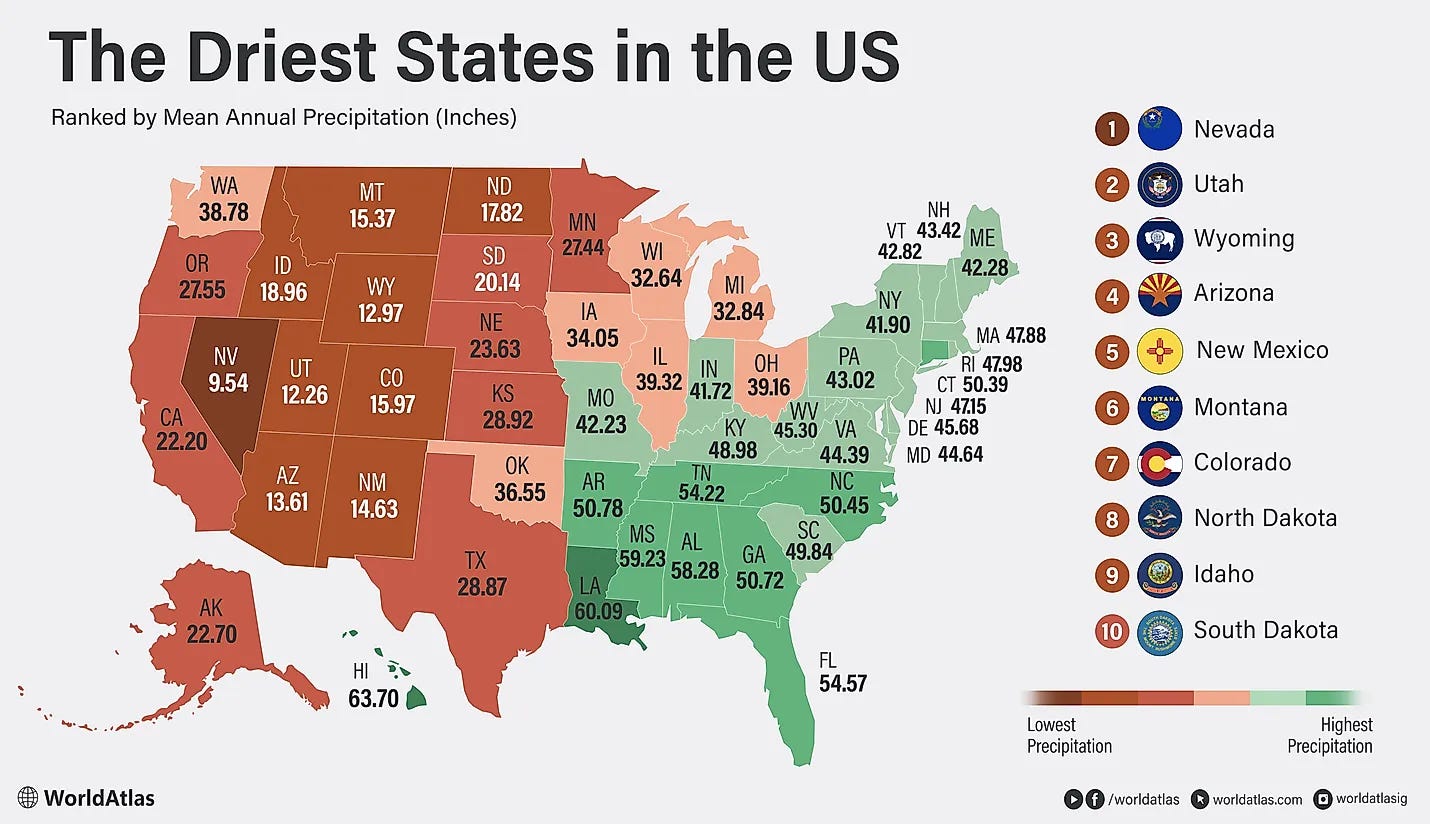
Readers in both Colorado—one of the driest states—and Georgia—among the wettest—are seeing lawn plants die or go dormant in this summer’s heat. Yet there are plants that evolved to thrive in the full range of conditions across the country—from less than 10 inches of rain a year to more than 60. And many evolved to tolerate abnormal periods of less than average rain (aka drought). Amazing!
Our challenge as yardeners—a fun puzzle, as far as I’m concerned—is to determine which plants will thrive in the existing conditions in our yards. Research can surface hypotheses, but the real learning comes when we test them by planting—and see which thrive and which do not. When a plant dies, it’s not a mistake, it’s learning.
How
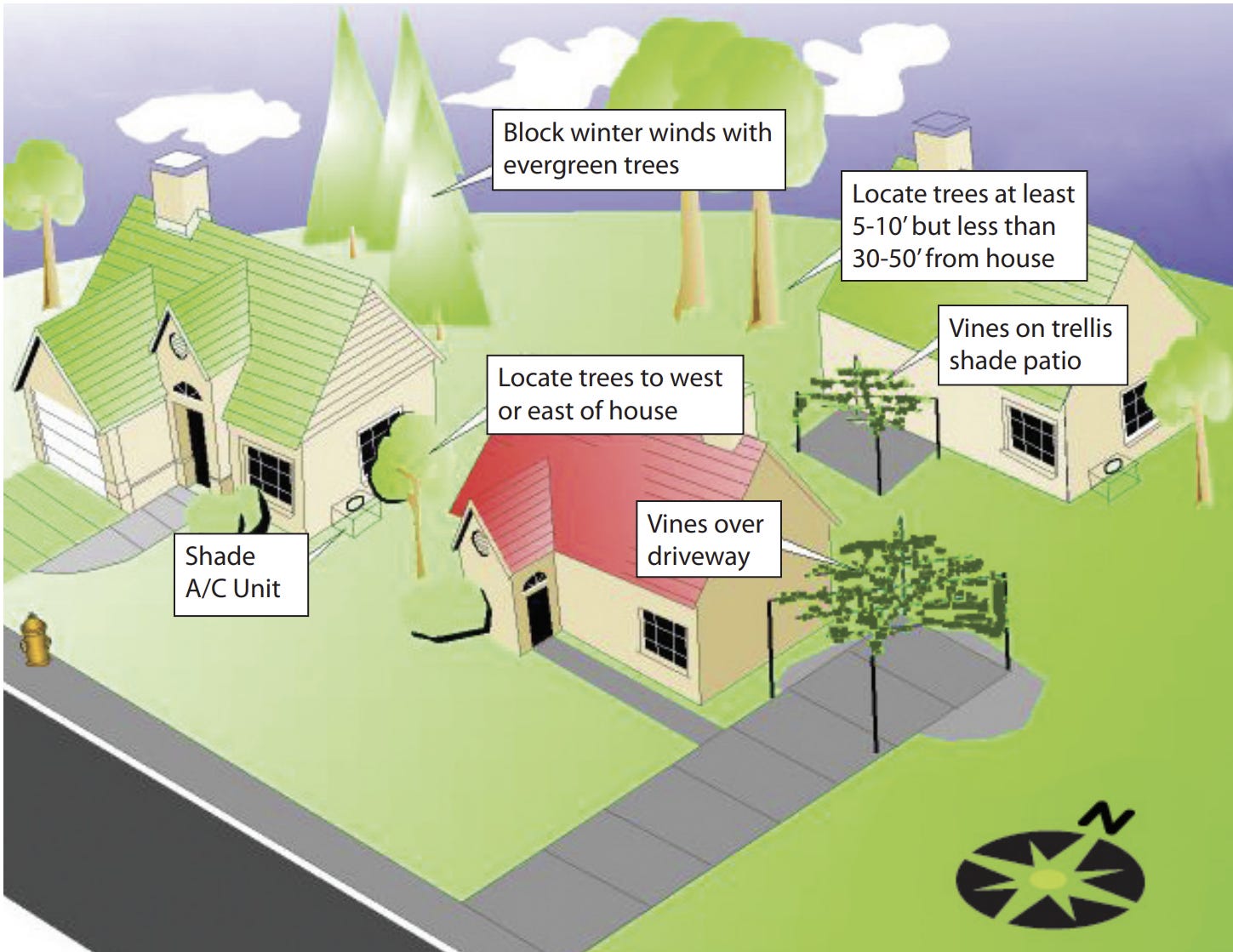
Although people often think of grasses and wildflowers when they hear “native plants,” shrubs and trees host as much as ten times the number of caterpillar species, the basis of our terrestrial food web. And trees thrive even in the Sonoran Desert, home of the gorgeous blue palo verde. Beyond their ecological value, trees significantly decrease ambient temperatures; for example, suburban areas with mature trees are four to six degrees cooler than new suburbs without trees. Trees can also decrease residential energy costs and increase home values.
Wow!
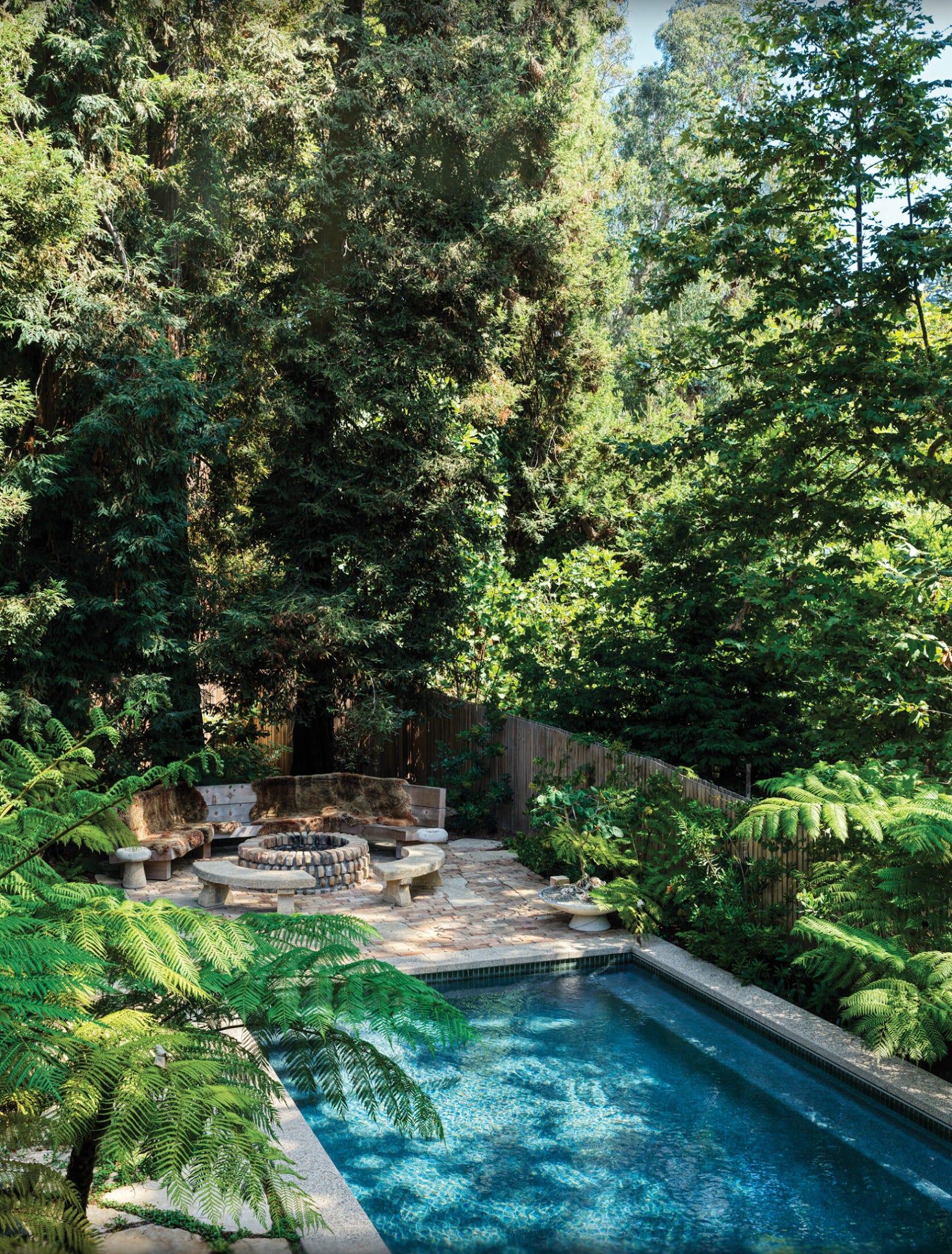
I love how cool—pun intended—this pool patio looks, even in hot, dry Los Angeles. I can imagine a large group enjoying the functional-yet-chic wood and cement furniture, which can be left out year-round. (The fur throws will have to come in:)
The garden was created within an experimental redwood grove planted in the late 1800s.
“As for the verdant grounds that sold Becker on the property, they have been reimagined by the AD100 landscape design studio Terremoto, who planted swaths of ferns and live oaks. “We wanted to do right by the redwoods and amplify the qualities of this unique setting,” explains the firm’s project lead Samuel Webb. On a typical day, you might find kids swimming in the pool, a surfboard slung next to the outdoor shower, and the pizza oven fired up. “We always keep the window open, listening to the creek,” Becker says dreamily. “You feel like you’re in the middle of nature.”—Architectural Digest
Digging Deeper
Thank you Jason, Kelly, and Margaret for pointing out that the hypertufa video I shared here last time was AI-generated. I so appreciate you skeptical, eagle-eyed readers! And I apologize to all of you for sharing without vetting the source. As Dartmouth professor Hany Farid told the New York Times recently, “Stop getting your news from social media. … An assumption that most of what you are seeing is fake is probably pretty good right now.” I only glance at social media (hence the video error) and do rely on trusted media outlets and sources, as he suggests. Unfortunately, it’s getting increasingly difficult to determine what those are. A potentially positive development are reliable AI slop detectors, per The Times. [gift link]
Claire, who says she has also had success planting into turf, shared an article by Nature Conservancy Director of Science and Stewardship in Nebraska, Chris Helzer about dealing with pervasive invasives like Kentucky bluegrass. He concludes, based on his research, “it’s more important to track plant diversity than to worry about how much territory bluegrass occupies.” Read the full article in Prairie Ecologist.
Perhaps the dangers of agricultural chemicals will get more attention now that Iowa gubernatorial candidate Rob Sand made it a pillar of his campaign, “Costs, corruption and cancer.” Cancer rates in Iowa, especially among young people, are rising steeply. Read more about Sand’s campaign in The New York Times [gift link] and Iowa cancer rates in The Washington Post.
For advice on how to choose a tree, see You Need More Trees—and So Do I, and on how to photograph your yard, see Capture Peak Garden Now with Your Phone.
I really appreciate all the work you do to make these posts, researching questions sent in - and choosing questions that are so specific which will need that research.
Woot woot! Thank you for highlighting the beginner guide from the Wild
Ones Front Range website! That was a labor of love!