

Dear Design Your Wild, How and where do you locate destinations and focal points?—Workshop participant
Intentionally! As pioneering user experience designer Jared Spool famously said,
Design is the rendering of intent. At the core of design is intention.—Jared Spool
Your intentions for your destinations—let’s hold off on focal points for a moment—are how you want them to function, to make you feel, and to look from the house and elsewhere in the yard.
What’s going to feel right
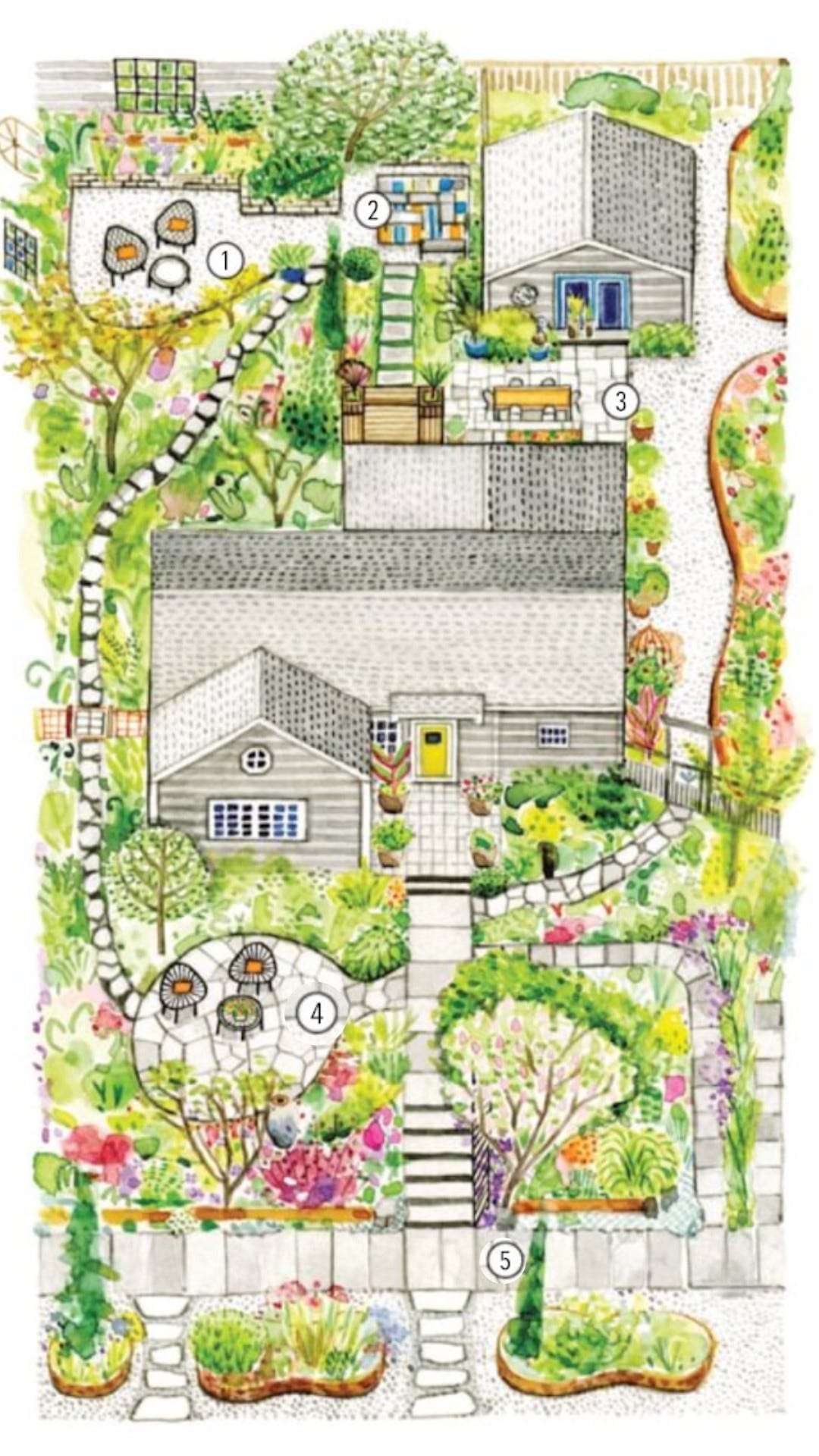
One way to make destinations that feel good is to leave plenty of room for plants around them. You can see how the destinations (as well as paths) in garden designer Darcy Daniels’ 5,000-square-foot Portland yard, illustrated above, are surrounded by plants, not turf, and not pushed against the house or fence. (Daniels shares the joy of gardening in the Pacific Northwest on her eGardenGo website and YouTube channel.)
Siting destinations in relation to the house also makes them feel right, appealing to our innate senses of proportion and symmetry. One tool to help establish a relationship to the house is regulating lines—imaginary lines extending into the yard from the walls and main doors of your house. You DON’T want to site destinations in relation to your fence or property line; instead, “blur” your property line with vines, shrubs and trees so it looks as if the trees in neighboring yards are part of your vast estate.
Establishing intentions
Here are what I imagine garden designer Darcy Daniels’ intentions might have been for the numbered areas in her yard:
“I want a cosy seating area, just visible from the house and studio, that will pull us into the most remote corner of the yard.” The chairs face the house in a welcoming posture. Note that this seating area is centered over the imaginary line that extends back from the left side of the house.
“I want a comfy gathering area nestled against the studio wall that’s visible and easily accessible from the back door.”
“Between the studio and the kitchen door, I’d like a dining table that seats six.” The table is centered in a dining area that extends from the right side of the back stoop to the right side of the house.
“I’d like a ‘social front yard’ where I can see neighbors and welcome them to join me.” This seating is centered between the sides of the front extension. The chairs face the street to welcome friends into the yard, angled and with semi-transparent backs so they also look attractive from the large front window.
These seating areas are destinations and their furnishings are also focal points—i.e., visual elements that attract your attention so you literally focus on them. I’m sure seeing their attractive and welcoming comfort pulls Daniels and her friends out of the house and down the various paths that connect these destinations and encircle the house.
“The best decisions I’ve made have been prioritizing places for people,” she says. The generous spaces serve as welcoming focal points throughout the garden.—Better Homes & Gardens Perennial Gardening
Besides signaling comfort and improving the view, focal points can create moments of surprise or pause and distract from something you’d rather not see.
“And I’d like to give visitors a moment of pause before they mount the steps to our house.” Solution? A sculptural small tree beside the path.
It’s not so easy fitting all your intentions into a harmonious whole, but once you have a rough idea, you can test it on the ground: Take a chair into the yard, place landscape flags—or branches—around your destination, test out your game lawn, have a friend stand in for a focal point tree, etc. And check the views from every conceivable direction—again and again. Eventually, you’ll start to feel where the right place is for each destination. And if you later change your mind, you can always move plants or mow a seating area into your meadow.
Dear Design Your Wild, When is it best to leave a non-native vs. remove it? I have a large yard (.85 of an acre) and have been adding native shrubs and trees for several years. However, one of the only two big trees in my yard is a very large, 18-year-old, non-native sawtooth oak. Would it be better to remove this tree and plant a native oak in its place or leave it to preserve the habitat and look of the backyard? We enjoy the shade and the birds and squirrels use the tree. A new native oak would take years to reach the same size.—Amy, Johnson City, Tennessee
I’m sorry to have to tell you, but your saw tooth oak is invasive, not just non-native.
With respect to native vs. non-native, Zoe and I generally use the “two thirds for the birds” guideline, based on research on the amount of native vegetation needed to support nesting birds. That means up to one third of an ecologically healthy yard’s biomass can be non-native turf, fruits and vegetables, and beloved flowers, shrubs, and trees. In fact, some studies have found gardens with a wide variety of natives and non-natives support even more insect biodiversity than all-native gardens (learn more here).
Unfortunately, saw tooth oak (Quercus acutissima) has been invading forests in the eastern United States, displacing more ecologically valuable native trees. Arborist Basil Camu, who argues persuasively against removing trees under most circumstances, says simply, “Invasive trees damage local ecosystems. They should be removed and replaced with native species.” [I recommend anyone thinking of removing a tree read Chapter 11 of Camu’s book, “From Wasteland to Wonderland” (ebook available free).]
Dead wood is habitat.
I wouldn’t worry about the temporary loss of bird and squirrel habitat. In fact, if you leave some of the dead oak as a snag or as a log wall, you’ll create habitat for thousands of other species that have fewer alternatives. The National Wildlife Federation recommends keeping three snags per acre and most urban and suburban neighborhoods have far fewer.
However, your and your family’s enjoyment of the oak’s shade and beauty is important, as are other any needs competing for the funds to kill or cut down the saw oak and buy a new tree. So it’s reasonable to consider the likelihood of your saw tooth oak (or its progeny) displacing native plants in natural areas. Oaks don’t spread rapidly by root like tree of heaven or airborne samaras like Norway maples. Is your tree close enough to wild areas for jays and squirrels to plant acorns there?
Like most oaks, this species is likely spread by squirrels and blue jays that transport and cache acorns by burying them in the ground, but don’t recover a substantial number that grow into new trees.—Louisiana Native Plant Society
If you do decide to replace your saw tooth oak, Evergreen of Johnson City carries a wide selection of locally native oaks, including fast-growing willow oak (Quercus phellos). Lindsey in their shrub and tree area enthuses about this beautiful, easy-care tree. A forty-gallon willow oak is about ten feet tall and can be expected to grow two to three feet a year after it recovers from transplant shock. For fastest growth, follow these watering guidelines.
—Heather
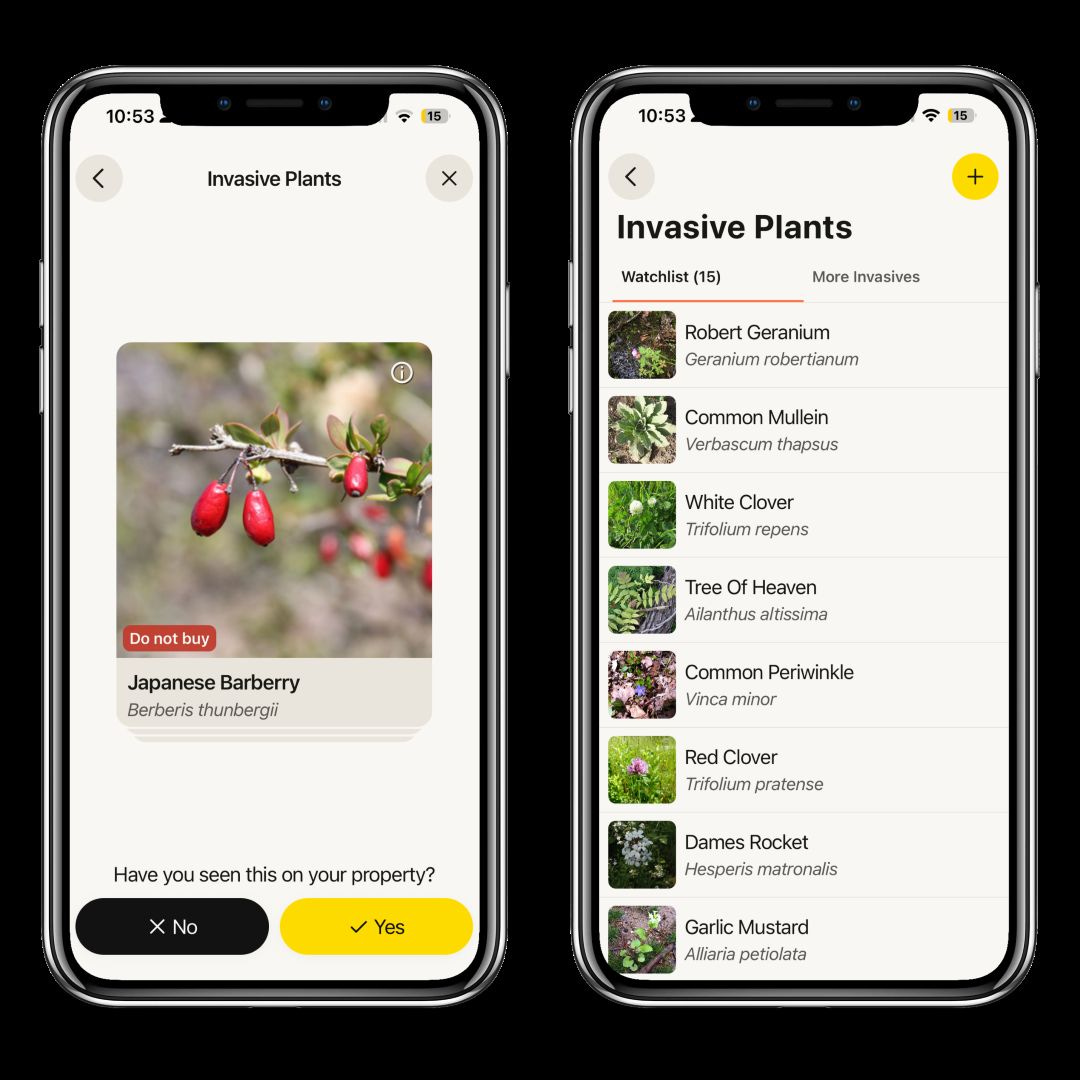
Hi, it’s Zoe here, jumping in with an update: The free Wildr Places app now shows you common, high-pressure invasive plants in your area. Open the app and navigate to your Place, then scroll down to the new invasives section.
Why, How, Wow!
Why? Making an outdoor place people love
I always come back to Doug Kent’s 10 research-based attributes of a restorative landscape when I’m ideating destinations and focal points and where to site them. You can incorporate all 10 into even the smallest yard, if you’re creative. Looking for ideas? Check out our linked Pinterest boards.
Douglas Kent’s 10 design attributes for a restorative landscape
Security—Encapsulate while revealing immediate surroundings
Accessibility—Stable ways to move through the landscape
Choices—Various ways to interact with the space
Comfort—Opportunities for rest, if not relaxation
Meditation—Places that make you pause and think differently (This is where focal points come in!)
Sun/shade—Thermal comfort by offering options
Stimulation—All senses: Feel, sight, hearing, smell, taste
Ambient noise—Rhythmic natural noises (chirping, water falling, leaves rustling)
Water—Audible and within reach
Views—From inside the house extend benefits, draw people outside

How: Putting wood (and Pete) to work
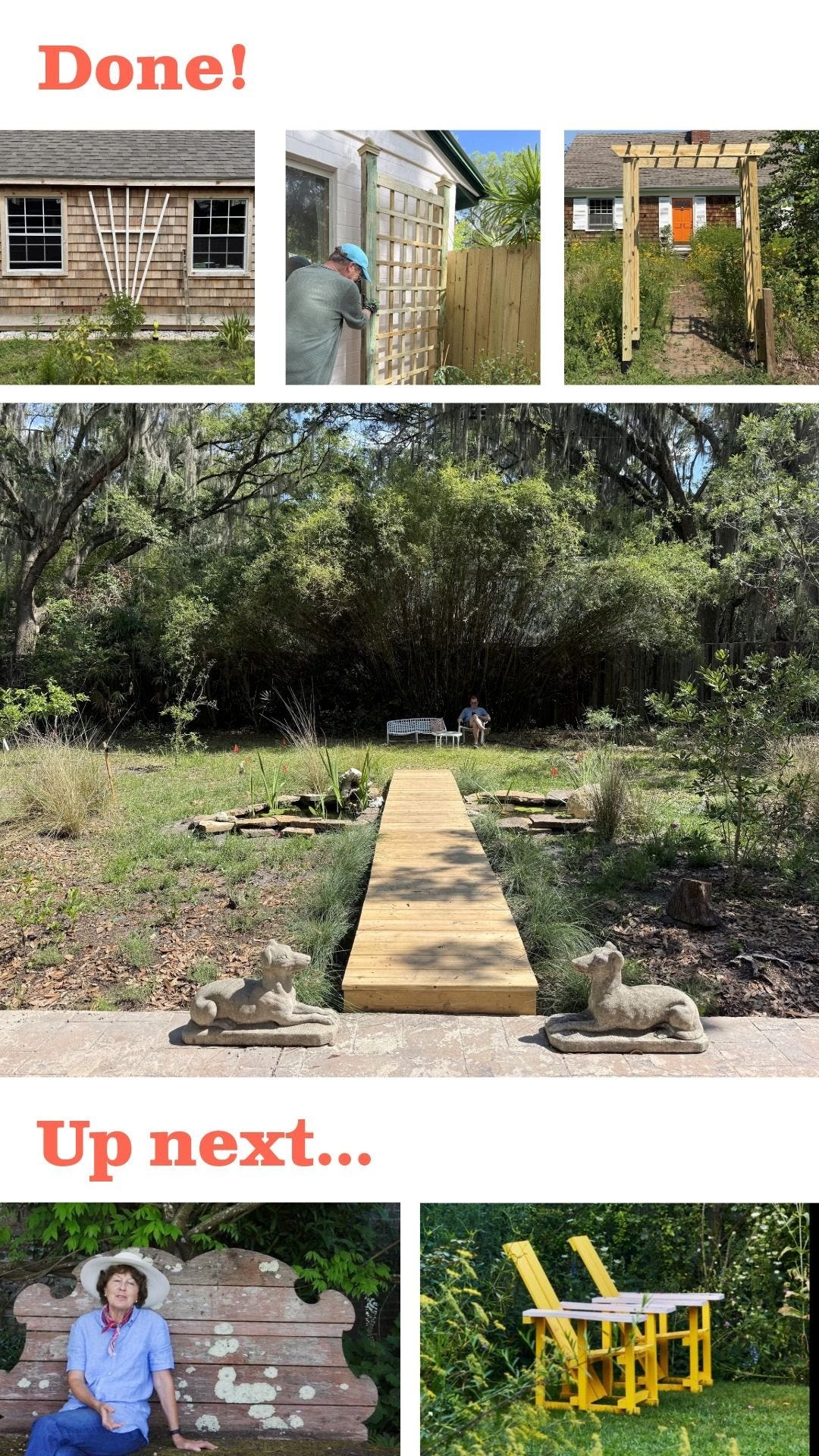
I am so lucky to have married an excellent carpenter! Pete, who also serves as our cartoon editor, has built an arbor, numerous focal points and, most recently, a stunning walkway that really makes our Gainesville backyard. I help where I can, but my impatience and carelessness make me more of a liability than an asset around the workbench.
That doesn’t stop me from coming up with new ideas to put Pete’s skills to work, especially since I found out even pressure treated wood is carbon positive. Wood is a also durable, cost-effective, and environmentally friendly. And it weathers to a grey that contrasts beautifully with greenery.
If you’re a carpenter or loved by one, you’ll find numerous plans and instruction videos online. For inspiration, check out these Pinterest boards, as well as our more general ones linked above:
Wow! Wood destinations and focal points
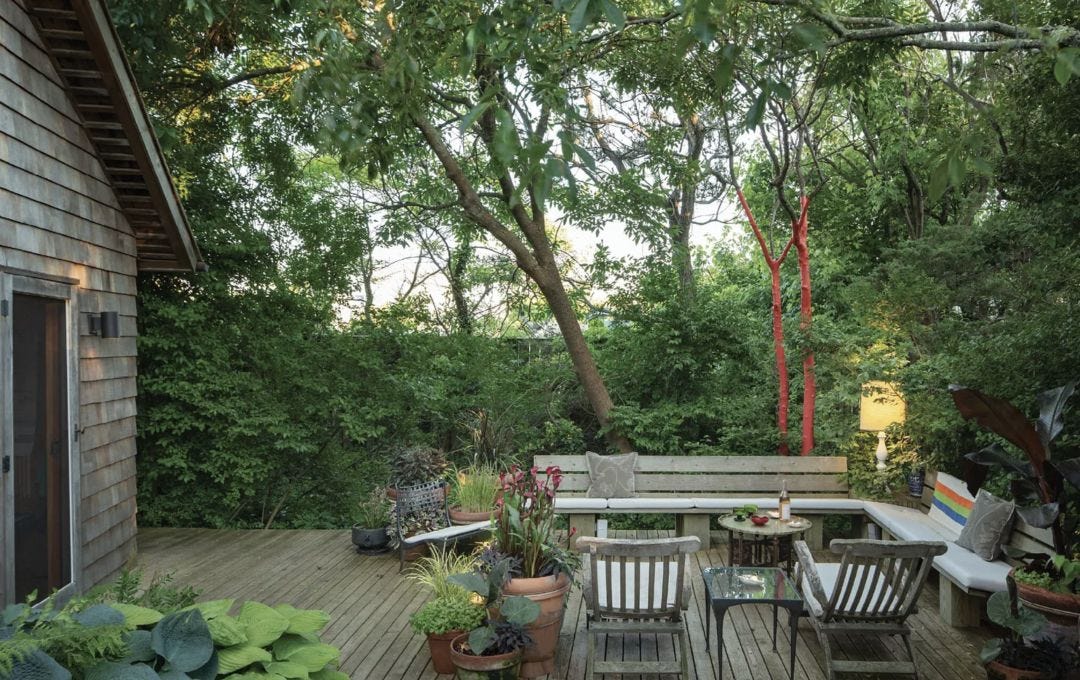
El-shaped deck seating (and classic steamer chairs)
Stepped walkway to deck
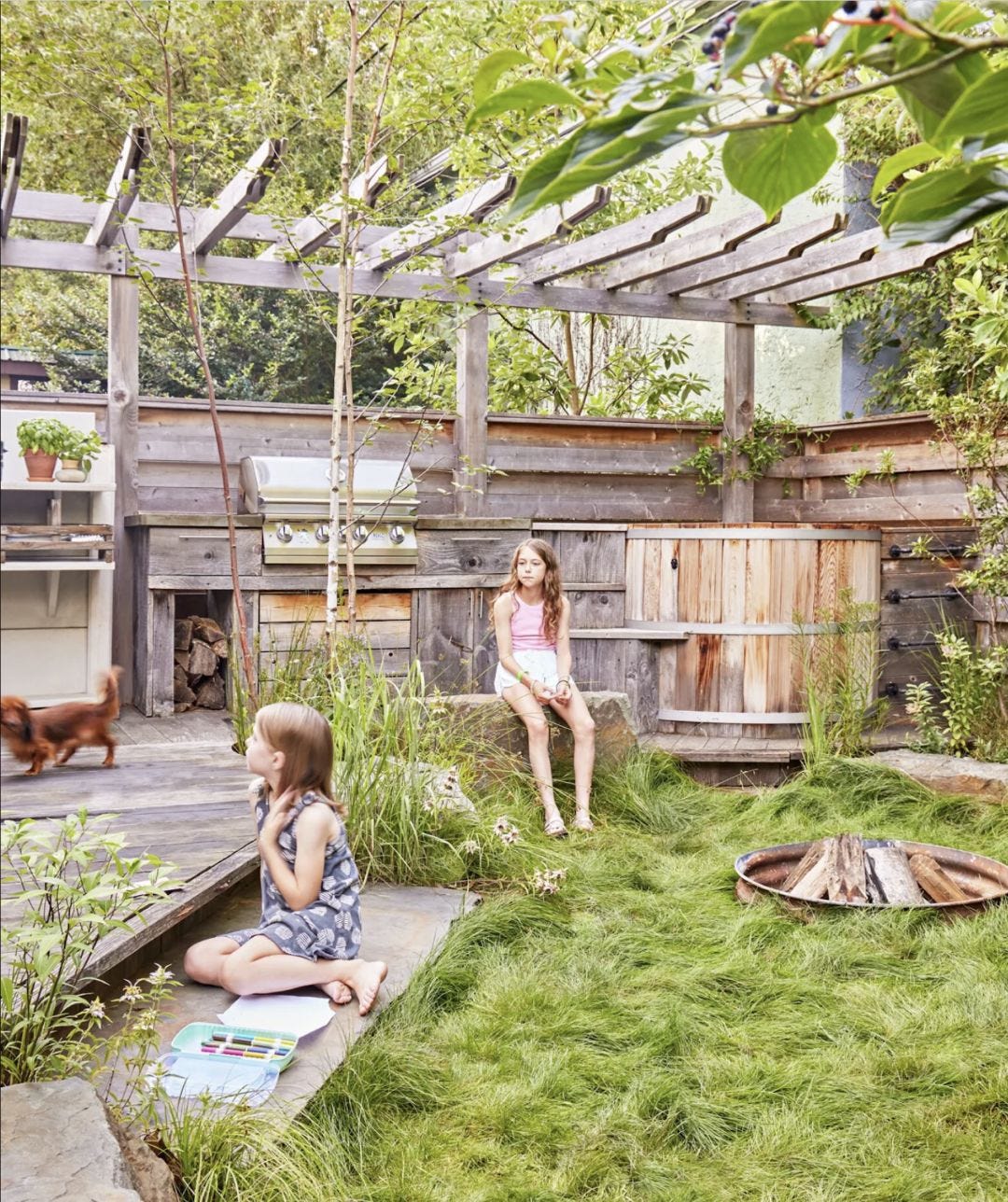
Outdoor kitchen-cum-hot-tub, plus arbor and deck
Digging Deeper
Stimulating all the senses, including taste, is a top 10 attribute of a restorative landscape, according to research. But vegetables are so much work! And they look ugly so much of the year! So I incorporate taste with fruiting shrubs and trees or pots of herbs and participate in sustainable farming via our fab Rhode Island CSA, Long Lane Farm. If you’re dead set on growing vegetables, I recommend making your veggie garden a destination (perhaps with a deer fence). For examples of beautifully designed kitchen gardens around the world, check out the scrumptious book, The Kitchen Garden.
The world is evidently going crazy for fireflies just as they are going extinct. According to The Wall Street Journal, this year’s parking lottery for the Great Smoky Mountain viewing period attracted more than 45,000 applications for 906 spaces. Learn from the Xerces Society how to make sure fireflies survive and see my article on limiting artificial light at night, including a DIY wood path light.
I’ve just started Ken Druse’s course on vegetative propagation of woody plants and am in love with layering. So fast! So easy! Here’s a video on how to ground layer shrubs.
And a video for those who wanted more info on micro forests.
Heather,
Thank you so much for addressing my question regarding my invasive(!) saw tooth oak tree. You have given me a lot to consider. I have Basil Camu's book and have just reread the chapter on trees. I agree with you and him that this tree needs to go! I will start working on a plan to make that happen.
I really connected with the section on making intentional destinations in your yard and the idea of using regulating lines to help with design. I am certainly guilty of creating my planting beds next to the house and fence and leaving large swaths of the lawn untouched. Since I have a large yard, it has been difficult to visualize destination "rooms" but I think this will be a great way for me to really dial in to the long-term design of our space.
INTRIGUED by the ground layering technique! Thanks for the link. I have Druse's Making More Plants and recommend it, if you can find it (it's out of print).