

Dear Remarkable Readers,
Zoe and I are thrilled to share that we are writing a book, tentatively titled Design Your Wild: 5 Steps to Transform Your Yard into a Place You Love and That the Planet Needs, to be published by Artisan/Workman in spring 2028. Thank you for helping make it possible! It builds on our popular yard layout and yardenality workshops, with instructions from sketch to maintenance. Your interest and support helped convince the publisher that people want a book like this. And your comments, corrections, and questions inform every word we’re writing—and we’re including many of your actual questions. So please keep your challenging questions and incisive additions and corrections coming in comments or by replying to these emails.
In other news, Zoe is hosting a Less Lawn More Life webinar on pocket forests with arborist Basil Camu on September 17 at 5:30 p.m. Eastern Time. Pocket forests are essentially a technology, a way of planting densely to encourage faster growth of woody species that you can apply to anything from a privacy row to a full-on forest. Register at joinwildr.com/events.
Finally, fall planting time is coming! Woohoo! Fall, not spring, is the best time to install plants in much of the country and late fall and early winter is the time to plant native perennial seeds. What’s in your fall planting plan? Mine includes an orchard underplanted with blueberries, fig, and cut flowers and seeding 17 new perennial species in a propagation station my husband Pete is building for me (photos soon).
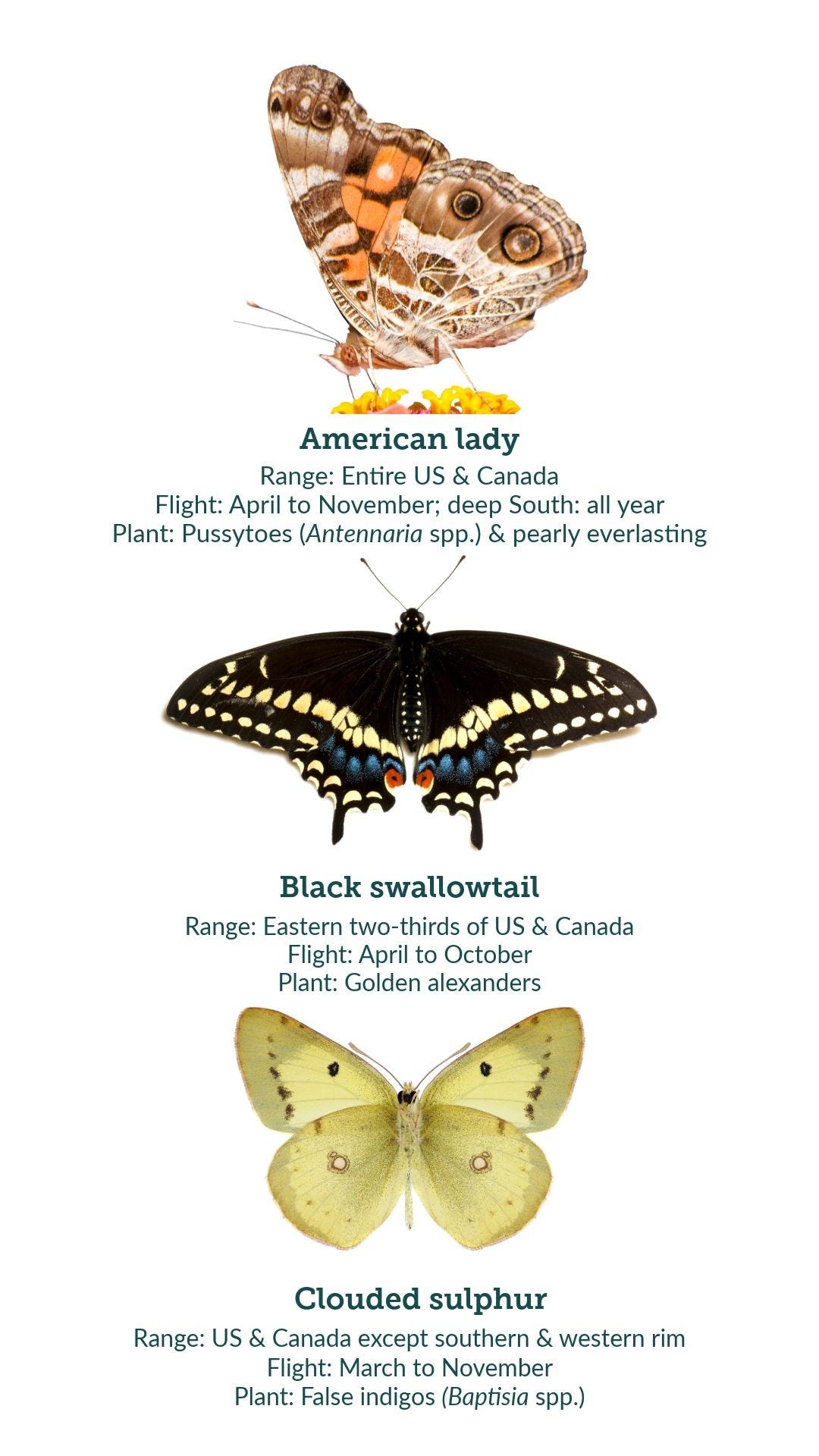
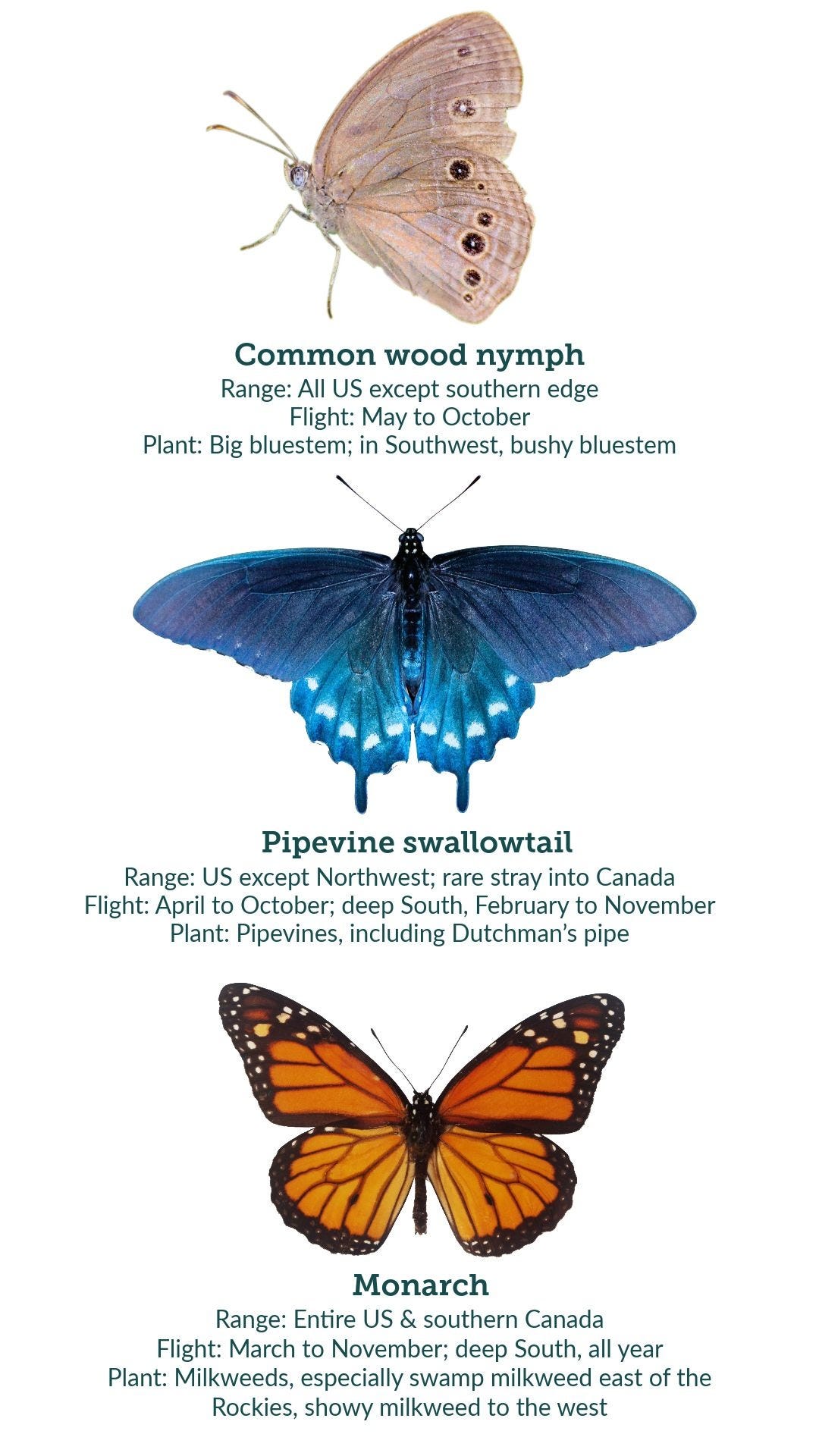
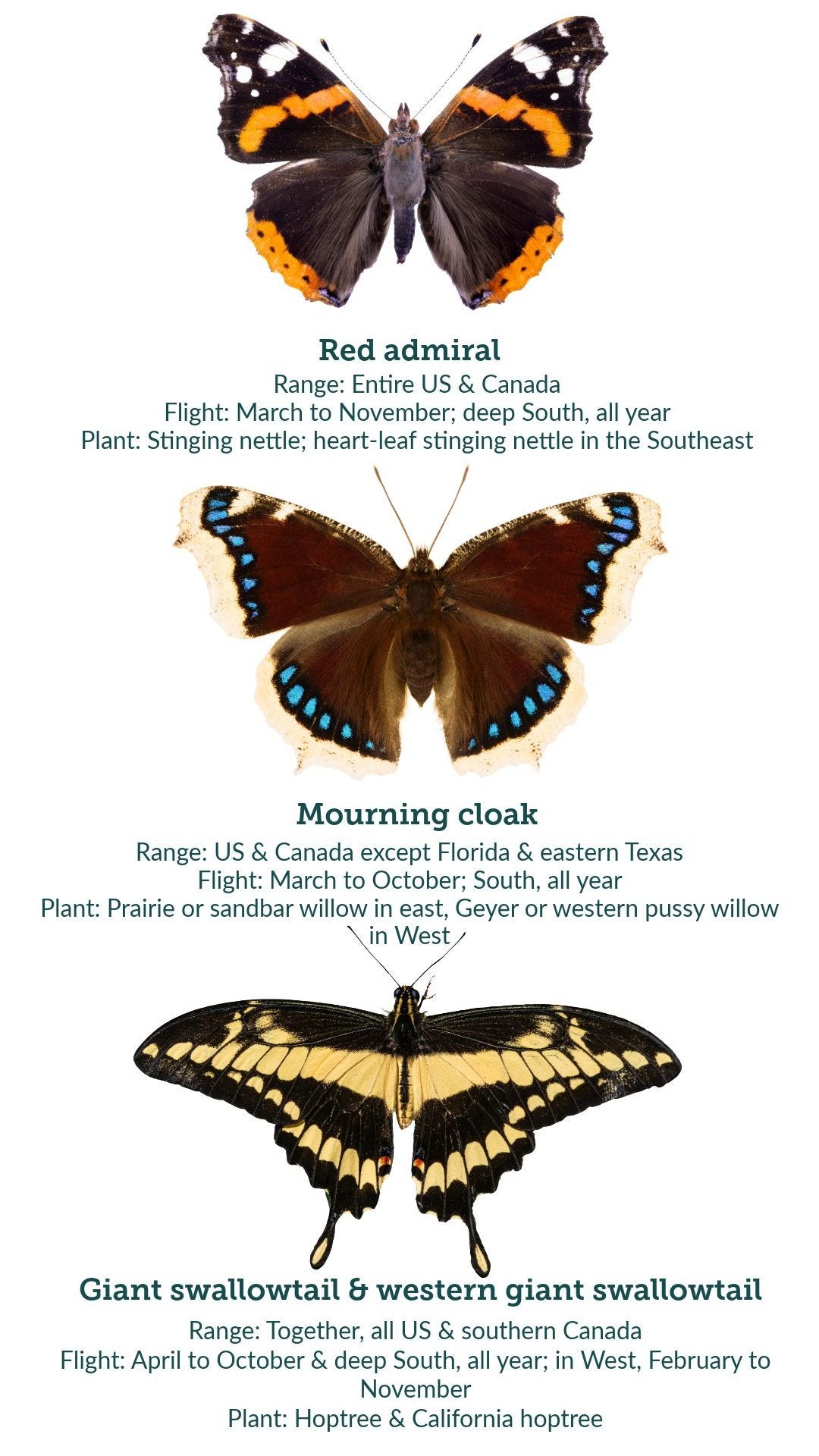
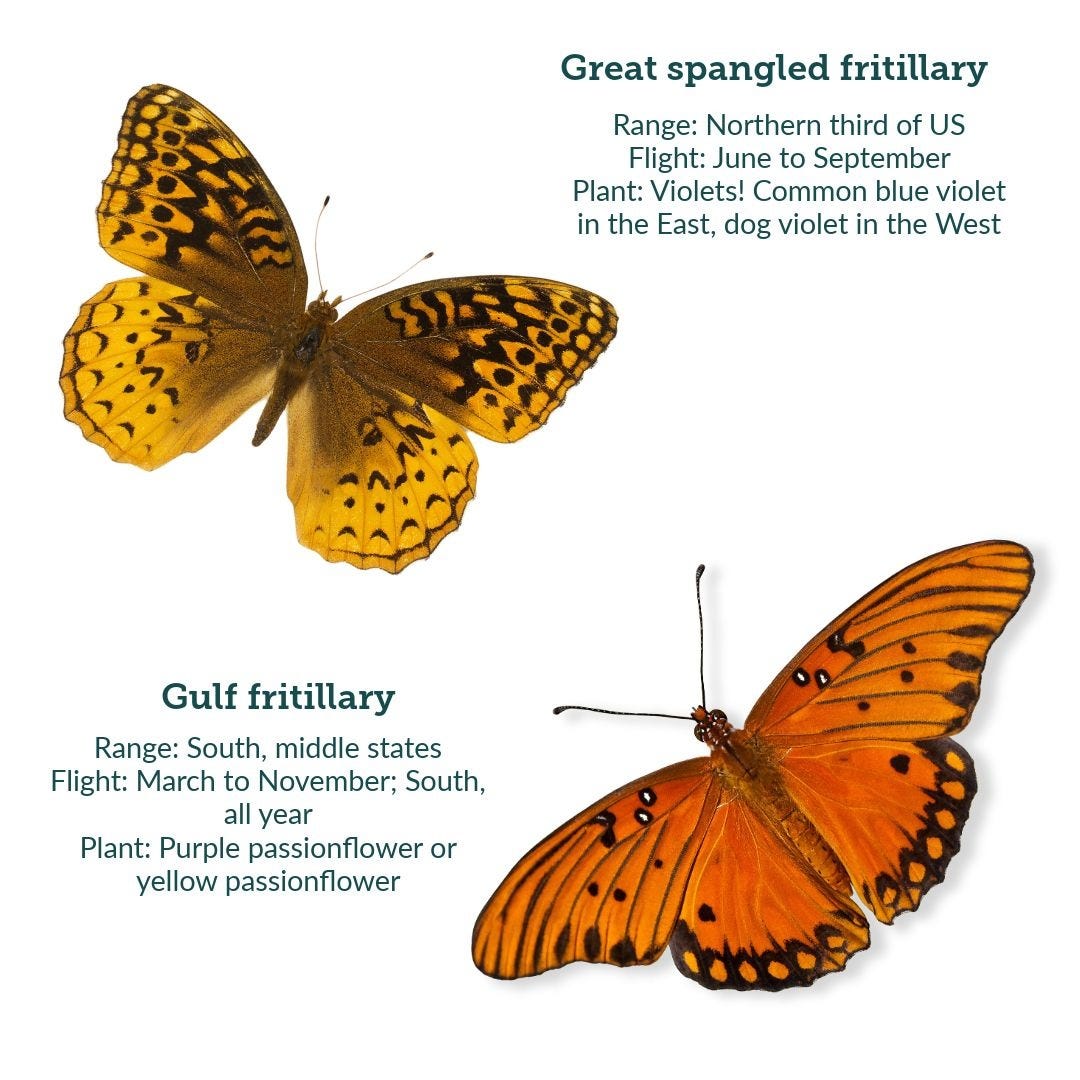
If you haven’t planned your fall planting, I hope you’ll be inspired to install host plants for some of these gorgeous butterflies. Happy planting!
—Heather
P.S. Zoe and I are looking for beta readers. If you are an experienced native plant gardener in California, Denver metro, Phoenix metro, or the Pacific Northwest and would enjoy commenting on our manuscript in exchange for a signed copy of our book and mention in the acknowledgement section, please email me.
Why, How, Wow!
Why? 11 Butterflies to Host
Doug Tallamy’s work on the importance of native plants to lepidoptera—moths and butterflies—and their caterpillars to birds remains my main reason for planting “two thirds for the birds,” i.e., two thirds native. We have planted lots of megahosts, like oaks, willows, maples, etc. But we also enjoy planting specific hosts for especially beautiful butterflies—like milkweeds for monarchs. (Right now, Pete is watching over several monarch caterpillars like a mother hen, hoping they metamorphosize before the wild turkeys find them.)
Here are my personal host plant recommendations for 11 showy butterflies found throughout the United States and Canada. As always, make sure to plant native species, not exotics with similar names. And plant perennials in groups (butterflies are nearsighted), leaves some rocks for them to sun on, and provide a container of moist mud or sand for puddling. And no pesticides (duh); butterflies are insects.
How: Living with Invasives
We’ve received so many questions about invasives recently that I’m aching in sympathy with your anxiety. Please remember these are merely plants, not the plague. Nurturing more natives is far more important than eradicating every last invasive.
But since you asked, here are the basic strategies we can employ as ecological landscapers, in order of the amount of disturbance they cause and work they require; as a rule, use the easiest, lowest disturbance method that works for a given invasive species. For example, cutting is generally preferable to pulling or digging because it doesn’t disturb the soil and encourage weed seeds to germinate (though pulling can be quicker and is immensely more satisfying). Note that you might choose a different method if you have a few stray plants than if you have a large infestation. And in all cases, make sure to plant natives in the invasives’ place.
Ignore; allow natives to shade out.
Plant and encourage vigorous natives with similar reproduction strategies to outcompete.
Cut before it goes to seed, by hand for strays or mower for large areas.
Cut to the ground repeatedly, not allowing the plant to photosynthesize.
Pull, preferably after the rain when the ground is soft.
Dig out roots.
For large areas, smother under cardboard and six inches of wood chips
For large areas, solarize for 60 days under clear agricultural plastic
Here are examples of how these strategies apply to specific invasives:
Struggling with bindweed since it arrived in a plant pot; also creeping Charlie.—Bec
Creeping Charlie (also called ground ivy) is a low priority for the horticulturalists at the famous native garden at Brooklyn Bridge Park, who publish their species-by-species weed strategies, so I’ve decided to pretty much ignore it in my yard, for now. (A weed is any plant out of place, so their list includes some natives.) If you do decide to tackle it—and it can be one of the satisfying ones—the preferred method is pulling.
Bindweed is more problematic, thanks to its deep taproot and secondary lateral rhizomes. If it’s growing among plants you want to keep, try persistent cutting at the base.
Crabgrass growing in tilled and newly seeded meadow.—Sheila, West Springfield, PA
Congratulations on your establishing meadow! Your photos show lots of furry black-eyed Susan seedlings that will flower next year. These should shade the soil so fewer nonnative crabgrasses (various species of warm-season annuals) germinate. If they do sprout, cut them at ground level before they go to seed; some people use a Dutch hoe to do this, but I’ve never gotten the hang of it. Because crabgrasses sprawl, mowing may not stop crabgrass from seeding. Keep an eye on your meadow next year to make sure additional native species are sprouting; if not, you may want to add some plugs to speed things along.
Torpedo grass replaced St. Augustine lawn.—Lee, Central Florida
Sorry, torpedo grass is one of the most difficult weeds to eradicate without chemicals. Your best bet is solarization—i.e., wetting the area and covering it entirely with clear agricultural plastic for six weeks midsummer (though now may work, given Florida’s heat). The USDA found that temperatures of 140 degrees kill torpedograss rhizomes. Unfortunately, cutting, pulling, and tilling can spur growth from rhizome fragments. Good luck!
A 10,000 square foot area mass of mugwort, kept mown this year.—Veronika
Mugwort is another rhizomatous invasive. For small areas and strays, you can dig out the rhizomes, which are extensive but shallow, trying not to leave sections to resprout. For a large area like yours, try solarization in full sun, per the horticulturalists at Brooklyn Bridge Park. Humane gardener Nancy Lawson says mountain mint, obedient plant, common milkweed, black raspberry, and pokeweed will also outcompete and replace mugwort. I encourage you to plant these or other vigorous natives, especially rhizomatous ones, to replace the mugwort and make sure it doesn’t grow back.
“Lawn” of mown hayfield plants at former farm.—Sandra
Hmmm, have any of you seen research on this? Most old hayfield research seems to be about natural succession, i.e., transition from pasture to forest over time. Hayfields apparently include mat-forming, non-native grasses like Kentucky bluegrass. Smothering or solarizing is the best option for eradicating these grasses. But if you have an area of mixed native planting and old hayfield—or a huge area like Chris Helzer manages for the Nature Conservancy in Nebraska—then just lean into his philosophy of maximizing diversity and accept the persistent presence of Kentucky bluegrass, as he describes in Prairie Ecologist (with thanks again to Claire for sharing this important essay).
Wow!
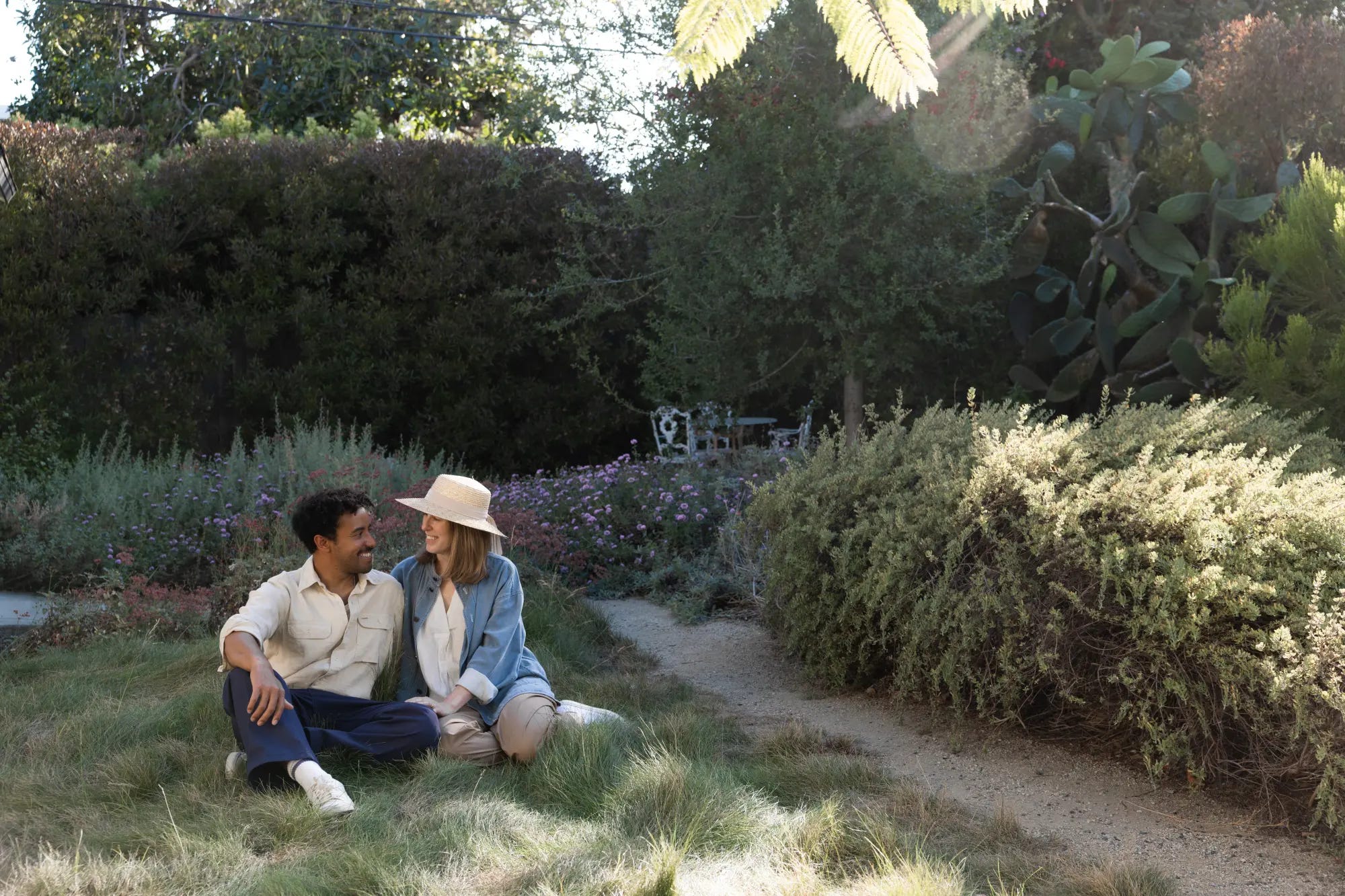
You know how I usually recommend keeping existing turf for paths and play when it thrives without chemicals or irrigation? Unfortunately, that’s not possible in much of California and the Southwest. An innovative solution is low-water native fescue turf sod from Soils Solutions, which has become “the No. 1 thing people like best” in a beautiful native yard featured in an LA Times story about a couple who used their wedding gifts to buy plants:
When Phoebe Novack and Brian Aggrey married in 2023, they eschewed a traditional registry for household luxuries or a modern honeymoon fund. Instead, they requested plants—dozens and dozens of them. …
“People remember,” Novack said. “They’ll come over and they’ll be like, ‘I see the oak tree’s doing well.’ ” …
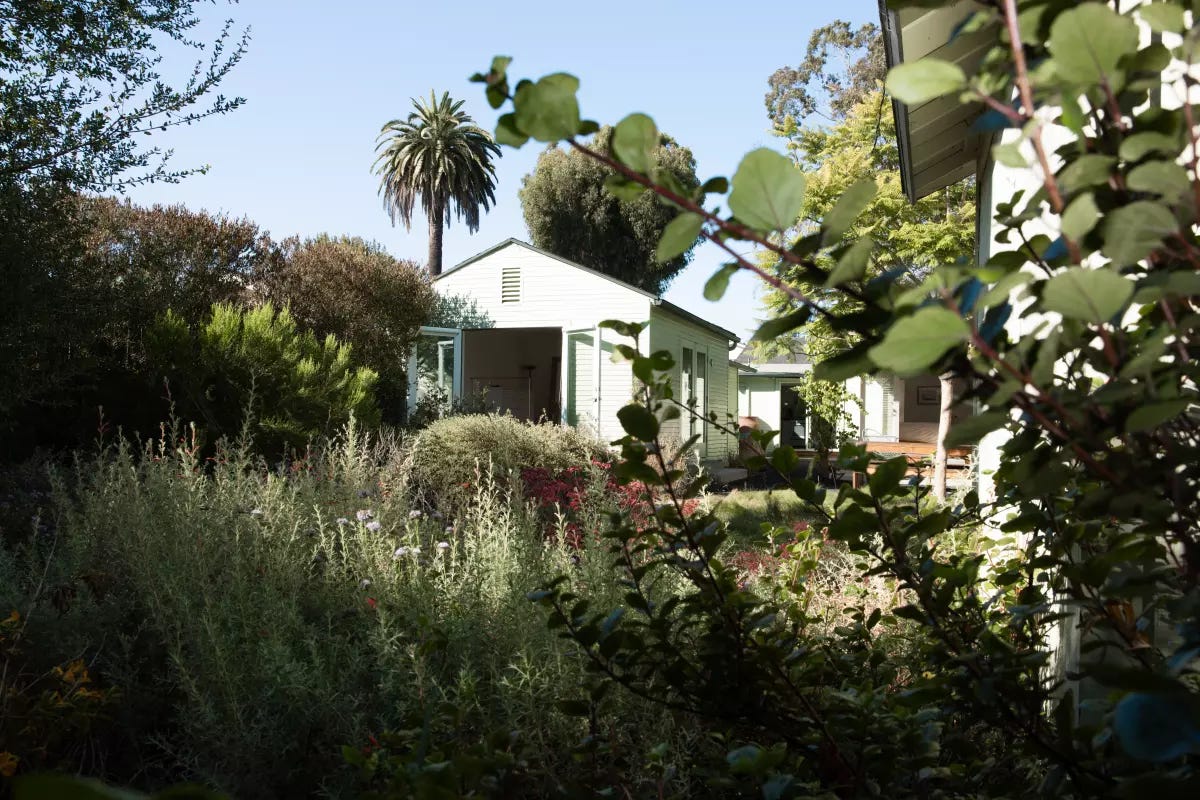
Garden installation began in pieces in 2022 and in earnest in early 2023. Three years on, Novack and Aggrey’s garden has become an aromatic, restful ode to Southern California’s coastal chaparral plant community. There are many manzanitas and one sizable coast live oak (Quercus agrifolia). There is a seasonal meadow of two dozen native wildflowers, and a year-round spectacle of sandaster (Corethrogyne filaginifolia) commandeers much of the front yard.
But the unexpected, undeniable centerpiece is their backyard’s strikingly lush, drought-tolerant native lawn that invites people and pets alike to unwind.—LA Times
For more ideas and inspiration, read the full story here.
Digging Deeper
Mosquitoes ruining your time outside? See my research-based strategies for avoiding mosquito bites in your yard.
For shrubs and trees to plant in fall, scan 75 Fabulous Native Trees for Wildlife for genera that intrigue you, then look them up in the Wildr Places app or website (joinwildr.com/plants) to find species native to you.
Northeasterners, check out the Northeast Seed Collective for local ecotypes, which preserve biodiversity and often perform better because they’re hyper-adapted to local conditions.
CONGRATULATIONS! I am so excited for your book.
Another resource for native seeds is Wild Seed Project (https://shop.wildseedproject.net/) I sowed some of theirs to great success last winter. Trying my hand at gathering some this year!
And FYI: The butterfly captions were hard to read on my phone (even with my readers!).
I transplanted four purple passionflower vines from my parents' house to my house last year and had dozens of gulf fritillary caterpillars.
This year, I had DOZENS of purple passionflower vines and more caterpillars than I knew the vines could handle, but that's the circle of life. The birds are feeding their young and the caterpillars are working their way through my plants, and I have butterflies everywhere.
Next year I'm going to have to be more on top of removing the vines from where I don't want them to be, or the whole house is going to be swallowed!