

Dear Design Your Wild, I just recently learned that I should be pruning young trees as they grow, something I know basically nothing about. Always something new to learn with native plants!
I apologize, dear reader. I replied to your above comment, “There are no shoulds after ‘right plant, right place.’ Those trees do fine in nature without any help.” I was wrong.
First, I neglected to say that watering after transplanting is another “should.” And as I dug into research by structural-pruning legend Edward F. Gilman of the University of Florida, I learned that newly planted trees need more water than I had previously recommended. (New guidelines below.)
All that sun isn’t natural
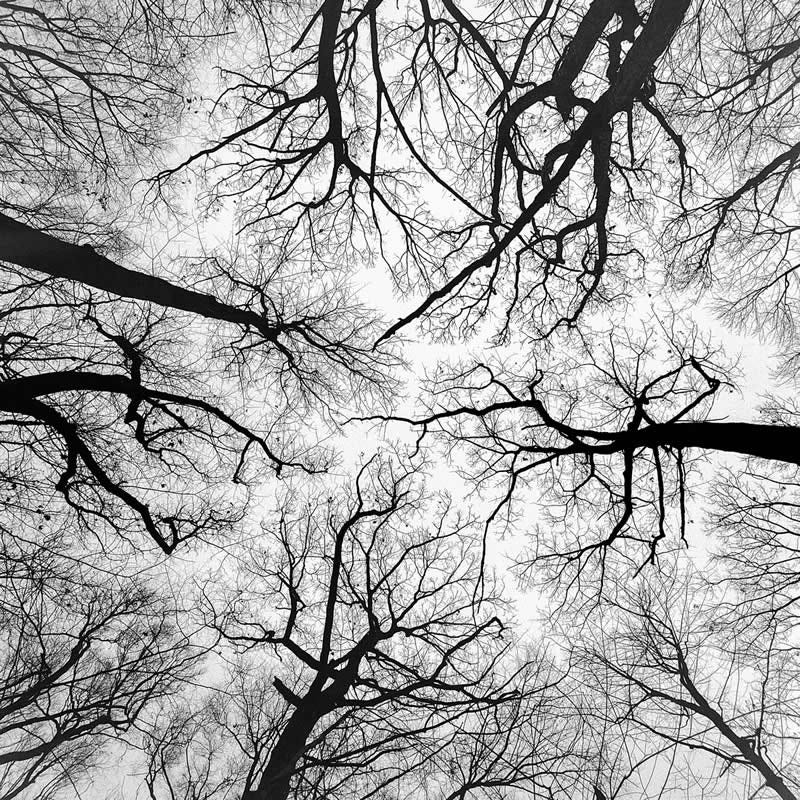
More relevant to your question, Gilman’s research convinced me that structural pruning of young trees is another should—or at least “worth considering”—for trees destined to be large or to overhang a walkway or seating area. As he points out, the way we plant trees in our landscapes is not natural: Trees in both nurseries and human landscapes are often “open grown”—i.e., spaced so as to give them sunlight all around. In nature, trees generally grow closely together among more established trees, receiving much less sunlight when they are young.
With the excess sunlight human landscapes provide, trees generate more branches and retain low ones they would naturally shed for lack of sunlight. Some branches receive enough sunlight to develop into a second trunk—called a codominant stem—that competes with the main stem or “leader.” Gilman demonstrated experimentally that removing extra branches and codominant stems make trees more stable during during snow, ice, and wind storms.
Twenty trees were blown using a wind generator up to 45 m/s (110 mph) maintained for 3 min. Each tree was instrumented with three orientation sensors at set heights along the trunk to measure its deflection. Thinning or reducing crowns significantly reduced upper trunk movement at all wind speeds, whereas raising did not. Lower trunk movement was not affected by pruning type.—Arboriculture & Urban Forestry
Valuable to wildlife, costly to humans
Dead trees per se are not an ecological tragedy; they support thousands of species—from woodpeckers to cavity nesters to microscopic fungi—and we need more dead wood in our landscapes to replace these creatures’ lost habitat. However, when large trees fail in human landscapes instead of the wild, we can suffer not only property damage, but the emotional toll of losing an aesthetic feature that the vast majority of us can only afford to replace with a much smaller tree. (The truly tragic—serious injury and death from falling trees—is fortunately exceedingly rare.) Unfortunately, the high cost of arboriculture—driven by its risks, specialized equipment, and insurance costs, as well as the skills involved—provides a motive for professionals to exaggerate these risks (a bias well documented by research, even among doctors).
So, dear reader, you are right. You should probably learn to evaluate and prune your young trees. Then evaluate each tree individually, weighing the benefits of pruning, given its location and eventual size against the potential harm to the tree of creating open wounds and decreasing its photosynthetic capacity. Structural pruning while trees are young is less costly to both you and the tree. Read on for evidence-based structural pruning guidelines.
Wait! I forgot another should: You should plant more trees (learn why). Good luck!
—Heather
P.S. I’d love to hear from readers with hands-on experience pruning young trees! Please comment below.
P.P.S. Re watering transplanted trees, a grand simplification of Gilman’s research-based recommendations for vigor is to water newly transplanted young trees (trunks under two inches) daily for two weeks, every other day for two months, and weekly until established—which can vary from three months in Miami to 12 months in Minneapolis. See Gilman’s tree irrigation guidelines.
P.P.P.S. Right now is a great time to buy saplings inexpensively through your local conservation district seedling sales. Search for “conservation district” + “seedling sale” + near me. Tree and shrub seedlings don’t experience transplant shock so catch up quickly to nursery grown plants. Install them close to each other—one every two square feet—to encourage rapid growth.
Why, How, Wow!
Why? Reducing future failure without damaging
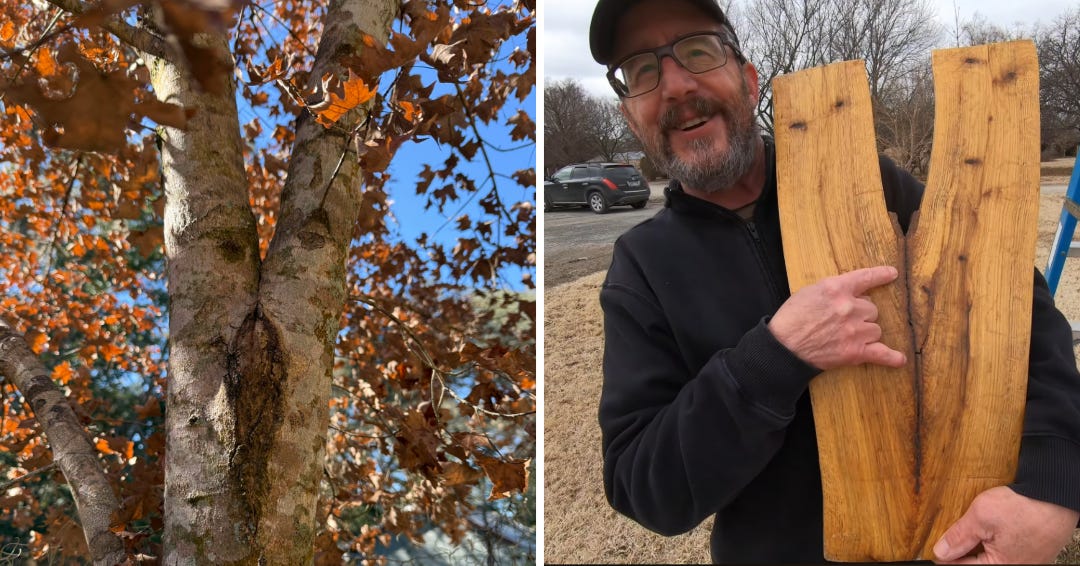
Codominant stems threaten a tree’s health because bark can become trapped in the joint between them—called “included bark”—acting as a wedge and increasing the likelihood the tree will split. When a mature tree splits, the wound is often so large the tree is unable to recover and eventually dies.
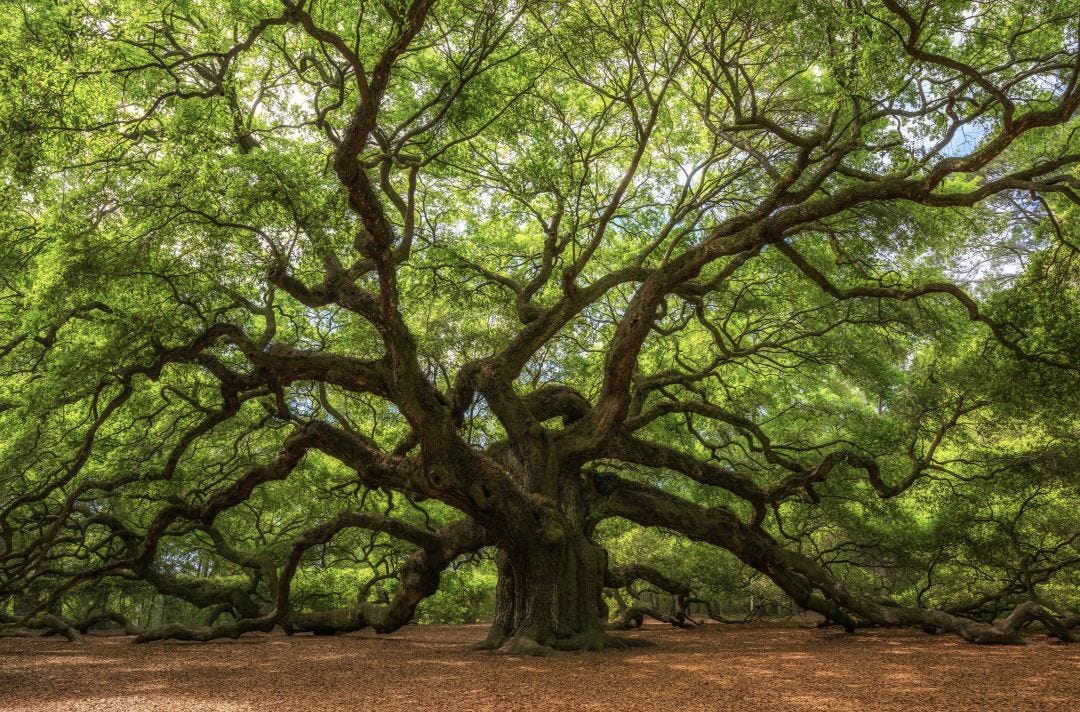
Extra branches and retained lower branches, compared to forest trees, can create attachments and a less aerodynamic structure, also increasing the likelihood of failure during a storm. Vertical branches (less than 45 degree angle to the trunk) and branches that are more than 50 percent the diameter of the trunk have relatively weaker attachments than more horizontal and thinner branches. Low branches around areas where people walk or drive can also be a hazard.
Balancing the benefits of pruning is the potential to harm the tree. Pruning is wounding, opening the tree, literally, to pathogens. According to plant pathologist Alex L. Shigo’s broadly-accepted CODIT model, trees don’t heal like animals, they compartmentalize. They respond to injury by forming internal boundaries that restrict decay and protect vital tissues. The process of isolating damaged tissue and sealing it off takes energy away from normal growth and development.
If we over prune, trees may respond by sending up thin, fast-growing shoots from their branches, called water sprouts, or their roots, called suckers. Live oaks, crabapples, dogwoods, maples, American hazelnuts, pawpaw, hawthorn, willows, black locusts, and various wild plums are especially susceptible. This can create a perpetual cycle of pruning and regrowth, making gardeners feel needed—and landscapers more profitable—without improving tree health.
How? Pruning is a skill—and an art.
Pruning trees is a skill best learned in a workshop, according to Bram Gunther, former head of forestry for the City of New York and a colleague of my daughter Zoe’s at Plan it Wild. Search “‘structural pruning’ + workshop + near me.” I’m certainly not going to attempt to teach you in this newsletter!
If you prefer to learn online, look for materials from a forest service or university extension program, which are most likely to be evidence-based. Start with the video introduction below from the Kansas Forest Service; it’s the best among many I watched. Before you take pruners to any tree, I recommend you also Google “pruning + [species name] + extension” to find reliable species-specific guidance.
See also the University of Florida’s pruning guide, including sections on timing and frequency—basically, when planting and 2, 4, 8, 14, and 25 years after. When you cannot reach high enough to prune from the ground, it’s time to call in a professional; search for one at the International Society of Arboriculture.
Having fallen down the pruning rabbit hole, how does this affect what I’m going to do in my yard?
Newly planted 3-foot flatwoods plum: Trim vertical sprouts on stem after flowering (which has already begun); over time, maintain a single leader and remove low branches over driveway.
Newly planted 6-foot fringe tree: Leave as is. It’s a small, shrub-like, multi-stemmed tree and doesn’t need a single leader.
25-foot Florida maple: Use pole saw to cut back (reduce) the smaller of two codominant stems to a lateral branch (up to 50 percent), and repeat in a year or two, if necessary. The codominant stem should subordinate over time. [My husband Pete, who studied trees as a wildlife biologist, says he wouldn’t do anything; maybe I’ll just remove 25 percent of the stem.]
75-foot live oak that hangs over our roof: Keep an eye on the fork between two codominant trunks. The swelling and darkened color suggests included bark. 😬[Pete: “It has done just fine for 100 years.”]
Wow! A beautiful tree-filled landscape
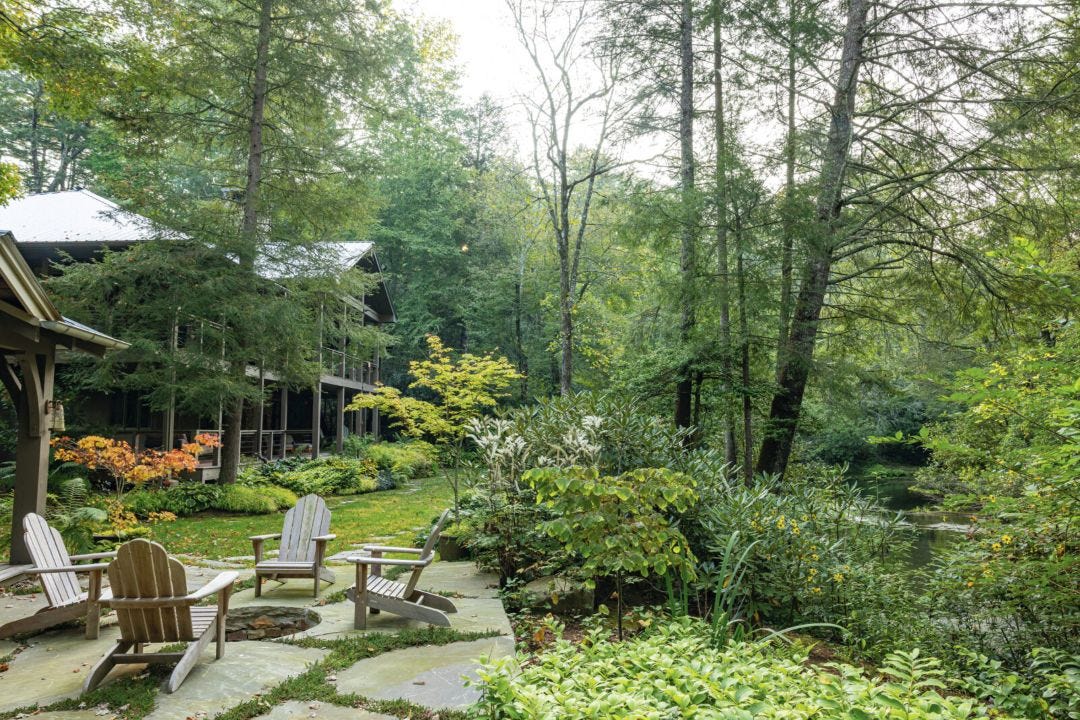
Finally, here’s some eye candy to remind you how beautiful tree-filled landscapes can be. Landscape architect Mary Dargan designed this yard at a North Carolina mountain retreat.
When she came on board, Dargan says, “there was nothing but grass and a couple of moth-eaten mountain laurels.” And so she conjured up a plan that wove plenty of function into the greenery—imparting “a feeling of transitional spaces and rooms” screened off by plantings, each terraced section flowing downhill into the next; harmonizing with the river and more than eighty inches of yearly rainfall to “direct, absorb, and enjoy water across the site”; using native plants whenever possible to welcome beneficial insects and songbirds (while including exotic species as needed, especially those like hellebores that deer find distasteful); installing “permeable paving” in the form of local river rock. A decade in, Dargan’s botanical acumen has helped transform the plot into a lush, verdant Southern Appalachian refuge—one that somehow feels like both an extension of the forest and a ferny oasis within it.—Garden & Gun

Upcoming Workshops
Open to Everyone
Yardenalities™: A Design Shortcut for a Backyard Makeover—TUESDAY!
Register for Yardenalities workshop on February 3 @ noon E.T. at Homegrown National Park.
Designing Gardens for Birds
Register for designing gardens for birds workshop on March 8 @ 5 p.m. E.T. at Cornell Lab.
Only for Paying Subscribers
We’re offering three winter webinars to thank paying subscribers for supporting our work and keeping the newsletter free for everyone. Read more about them here.