

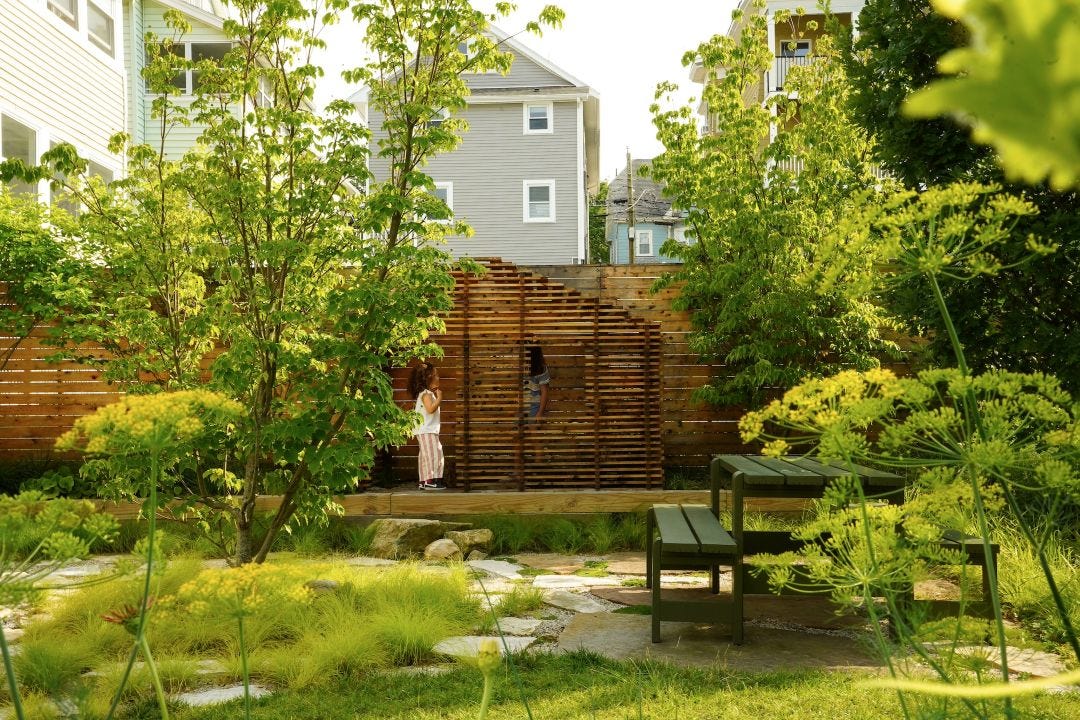
Yes, I’m celebrating YOU, because YOU, my dear subscriber, are an ecological success story. By eschewing pesticides and adopting ecological landscaping principles, you are supporting biodiversity in your yard. And by doing so, you’re also improving your and your family’s health. And you’re inspiring others around you. Go, you!
As you start to think about how you’ll continue to transform your yard in 2026—because yardening is a process, right?—here is recent research to remind you why you’re such a biodiversity superstar:
Thousands of arthropods
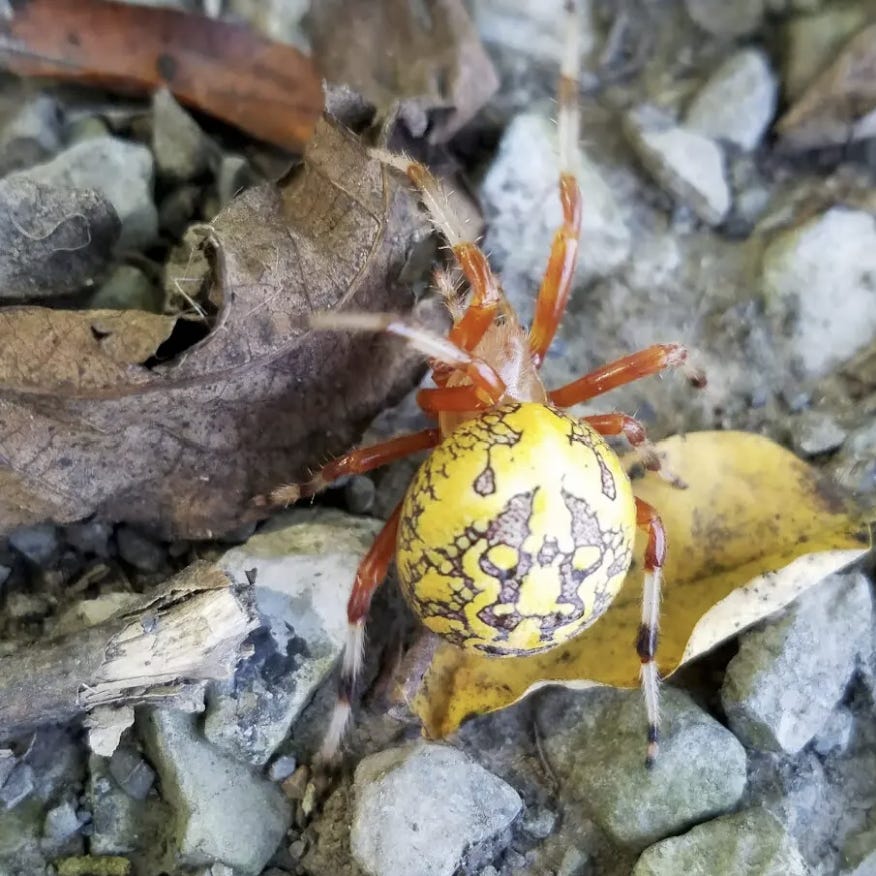
Wherever you left leaves in the fall, thousands of insects will emerge in the spring—about twice as many in number and many more species than if you’d removed those leaves.
In fact, Maryland state entomologist Max Ferlauto and colleagues found that almost twice as many butterfly and moth species emerged from test areas where they left leaves in suburban yards compared to where they removed them.
“In a square meter of yard where you leave your leaves, there’s on average almost 2,000 insects that will emerge over the course of the spring,” [Ferlauto told Margaret Roach of the New York Times].
That total number doesn’t include decomposers and detritivores like earthworms or millipedes, he said, nor the tiny insectlike soil animals called springtails. What it does include are arboreal arthropods—species that spend only a portion of their lives in the fallen leaves and the rest above ground: butterflies and moths (about 20 will emerge), parasitic wasps (about 300), beetles (almost 400), more than 100 spiders and 1,000-plus flies of various kinds. …
“When you remove the leaves, instead of retaining them,” Dr. Ferlauto said, “you reduce the number of moths by 45 percent, the number of spiders by 56 percent on average, the average number of beetles by 24 percent.”
Besides those declines in abundance—the total number of individuals—there was also a reduction in species richness, the diversity within each group. In butterflies and moths, for example, that fell by 44 percent.—The New York Times [gift link]
Small areas, big impact
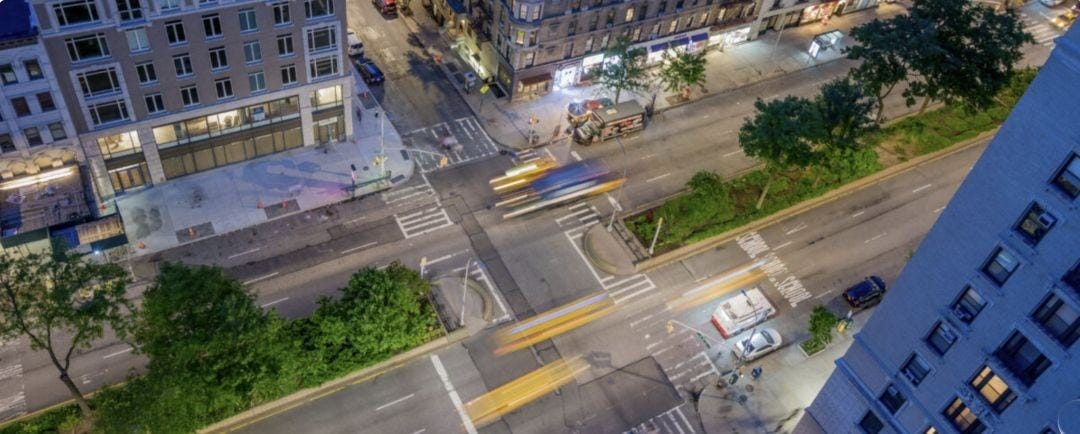
Think your garden is too small or your neighborhood is too urban to support wildlife? Think again. In the year and a half since ecologists replaced non-native plants with native goldenrod, columbine, aster, and sedge in a tenth-acre plot in the middle of New York City’s Broadway—a busy boulevard in the densest city in the country—citizen scientists have so far documented 127 plant and animal species on iNaturalist.
…which reminds me to make a resolution for 2026:
Document my yard’s insect biodiversity. Want to join me? To track plants and animals, including insects, take a picture and ID it with the iNaturalist app, which will identify it and track its geolocation. (Download from Apple or Google.)
Read on for my other resolutions…
“Traditional” gardens can be biodiversity hotspots
If you’re a longtime gardener and love your daffodils and peonies, I celebrate you! And if you’re a newby who yearns to grow roses in honor of your grandfather, go for it!
Biodiversity studies of gardens cultivated for beauty first, like England’s Great Dixter and Pennsylvania’s Chanticleer, have demonstrated the ecological value of their mixes of thousands of exotic and native plant species. Chanticleer’s study documented 1,157 animal species, including an unnamed species of crayfish, a bee species never before found in Pennsylvania, and 23 bird species rated of greatest conservation need in the state. Demonstrating the unique role of gardens compared to wild places, Chanticleer’s 509 moth species include many forest understory specialists that are less common in the wild as a result of invasive plants and deer browse.
Personally, I have become less doctrinaire since reviewing these results. So here’s my second resolution:
Loosen up. Have fun incorporating more plants native elsewhere in the country, as well as non-invasive exotic plants, into my new garden. I will still aim for more than “two thirds for the birds”—i.e., two thirds locally native vegetation to support breeding pairs, per Doug Tallamy—but one third is a lot, and increases as I add more natives. (If you’d like to see if a favorite exotic plant is invasive, check the lists at the Invasive Plant Atlas of the United States.)
The Chanticleer example, as well as research like Maryland’s leave-the-leaves study, underscores the importance of landscaping practices to biodiversity. Here is Chanticleer’s list of what makes a biodiverse garden; you can learn more from their biodiversity study.
Grow a diversity of woody plants.
Grow a diversity of herbaceous plants.
Provide soft-pithed plants for cavity nesters.
Provide logs, snags, and sticks.
Leave the leaf litter.
Limit pesticides.
Reduce outdoor lighting.
Differing tastes boost biodiversity
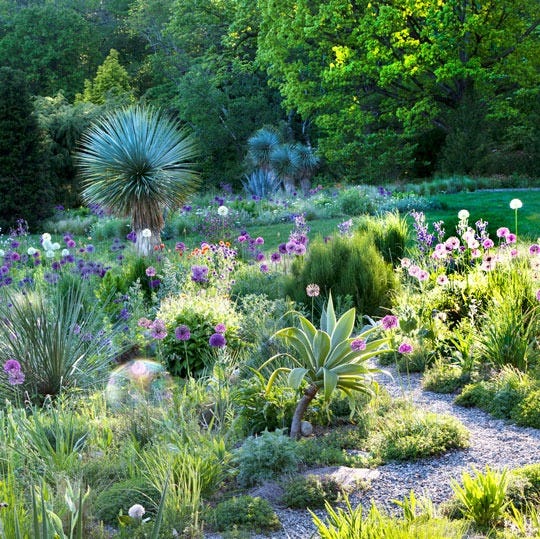
Maybe you’ve stopped irrigating and using pesticides and planted a few native shrubs, but you still love your lawn. I celebrate you! As English garden designer and biodiversity advocate John Little pointed out in a recent Plantastic podcast, taste creates edges and complexity and hence more biodiversity in urban and suburban areas.
So if you’ve got one garden where … a bloke wants to cut the whole thing to lawn—because you usually have a bloke who loves cutting lawn—that’s OK, because next door may well have longer grass or an herbaceous area, and the next garden might have more shrubs. … That is why gardens are so good [for biodiversity], because they are complex, because they are driven by people’s taste.—Plantastic Podcast with Dr. Jared
(If you’d like help making your yard more biodiverse while expressing your personal taste, plan to join my daughter Zoe’s and my “yardenality” workshop on Tuesday, February 3, at 11 am Eastern time, hosted by Homegrown National Park! Registration details to come.)
Resolutions and webinars
OK, I admit, I don’t really make resolutions, but I’m big on planning. I’m constantly thinking ahead and making lists about what I’m going to do in the garden. And the dawn of a new year, when there’s less going on in my yard and the cold keeps me inside (even in north Florida), is my favorite time to plan. So here are the other major changes I’m going to make this year:
Build ponds, starting with two in Gainesville. They are so important to biodiversity and they are the “wow” factor in the backyard design Zoe sketched when she visited. I’ve already ordered all the supplies and Pete and I will start digging this month. Stay tuned.
Plant a microforest. Zoe’s colleagues at Plan it Wild, leaders in creating microforests, tell me I only need a five-by-eight area. I’m going to lean on them to teach me—and you, too.
Learn evidence-based pruning. So far, most everything I can find about pruning is based on tradition, not research. But I’m on the trail of a scientist who has actually done studies…. I want to know: Which pruning actually impacts plant health? And, even if pruning is just about aesthetics, what are the best methods for which plants?
Spend smarter. Seed more. Propagate from cuttings. Invest in high impact features (like the ponds). Be patient: Wait to see which of the 40 new plant species in our new Gainesville yard thrive before planting more. And that’s hard for me….
What are YOUR plans for your yard this year? Please tell me in a comment. And also let me know if you’d be interested in a webinar or workshop on any of the topics I’m focusing on. Zoe and I will be soon be announcing our winter webinar series.
Wishing you health and happiness in 2026,
—Heather
P.S. To see “before” pics and learn more about how Lu La Studio transformed a parking lot into the gorgeous garden above, read Laura Fenton’s Gardenista article.
Just a comment - you refer people to iNaturalist for help with identifications. Wonderful as this, and other similar tools, are they are not yet infallible and their suggestions should not always be taken as absolute. Unless you are certain it's always best to cross check with another source. iNat will set you on the right track and narrow the field of possibilities but sometimes it is wrong.
I think I’ll take on your Inaturalist resolution too! I typically use it just to ID but don’t save to the site. Save I shall!